
Kemi Osukoya | FINANCE & INNOVATION
May 8, 2026
For Lisa Cook, the return to Dakar the week was more than a policy stop or central banking engagement. It was a return to the place where the questions that would shape her career first began to form.
Long before she joined the U.S. Federal Reserve System and became one of the world’s most closely watched monetary policymakers, Cook arrived in Senegal as a graduate student at Cheikh Anta Diop University intending to study philosophy and African thought. Instead, the everyday realities of the economy around her pulled her toward a different discipline altogether.
Why, she recalled asking herself, did a ballpoint pen that cost a few cents in the United States sell for the equivalent of $10 in Senegal? Why were some countries rich while others remained poor? And could emerging economies ever truly converge with developed markets?
SHOP FOR THE PERFECT GRADUATION GIFT
Those questions, first sparked in Dakar decades ago, brought Cook full circle on Friday, as she returned to the Senegalese capital to address one of the financial system’s newest frontiers: Tokenization, digital assets and the growing convergence between traditional finance and blockchain-based infrastructure.
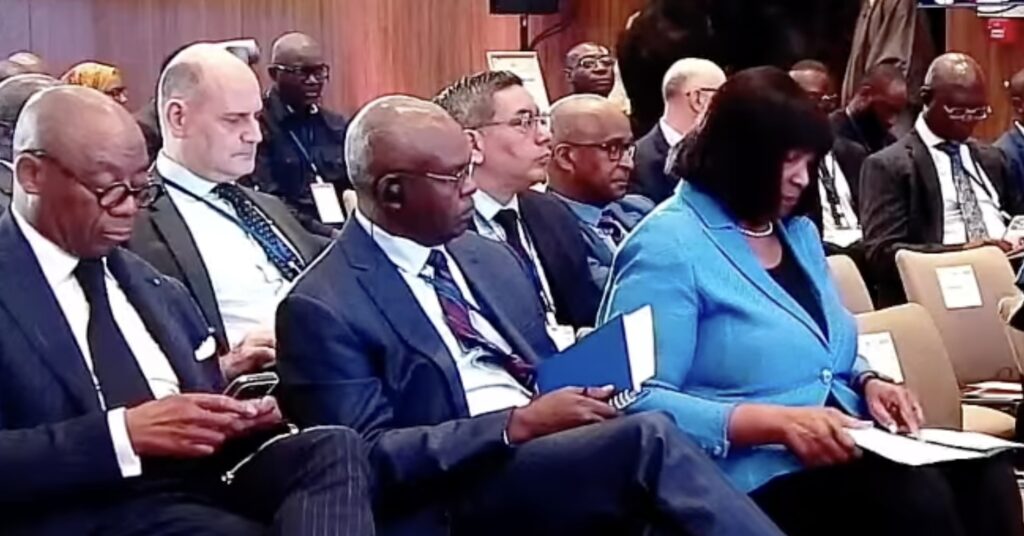
Speaking to Central Bank Governors, financial regulators and ministers participating in the Central Bank of West African States (BCEAO) conference, Cook framed tokenization not as speculative hype but as a potentially transformative tool for emerging markets, especially across Africa, where financial innovation has often leapfrogged legacy banking systems.
Few regions illustrate that dynamic better than Africa itself. Long before Silicon Valley embraced digital wallets and embedded finance, African fintech firms were already reshaping how money moved across borders and between households. Services such as M-Pesa helped pioneer mobile payments at scale, allowing millions of East Africans without traditional bank accounts to send, save and transact money through their phones.
That experience, Cook noted in her speech, shaped her own interest in technologies that reduce friction in payments and capital flows. While working in Rwanda and across East Africa in the late 1990s and early 2000s, she watched firsthand as mobile-money platforms began altering the relationship between finance, technology and inclusion.
Now, she said, tokenization could represent the next evolution of that shift.
At its core, tokenization refers to the process of digitally representing ownership of assets—from bonds and currencies to money-market funds and commodities—on distributed ledger systems such as blockchain networks. Transactions can then be automated through so-called smart contracts, allowing assets to move more efficiently across digital infrastructure.
Advocates of the digital asset argue the technology could modernize financial markets by reducing settlement times, lowering transaction costs and improving transparency. In traditional markets, cross-border transactions often require multiple intermediaries and can take days to settle. Tokenized systems, by contrast, they say could allow multicurrency and multi-asset transactions to occur almost instantly and around the clock.
For West Africa, and the entire continent, the implications could be significant.
Cook pointed specifically to opportunities within countries tied to BCEAO, where tokenization could help streamline foreign-exchange transactions, liquidity management and cross-border trade across the region’s interconnected economies.
SHOP FINE JEWELRY
The technology could also broaden access to capital markets in economies where formal financial participation remains limited. Fractional ownership enabled through tokenized assets, for example, could allow smaller investors to gain exposure to financial instruments previously out of reach.
She stressed that the promise of tokenization lies not in replacing the traditional financial system, but in improving its efficiency.
Financial institutions, she argued, are increasingly exploring the technology because existing markets remain fragmented, dependent on manual processing and constrained by legacy infrastructure. Tokenization, particularly when combined with programmable smart contracts, could automate collateral management, intraday funding and complex transactions spanning multiple currencies and asset classes.
The market is already growing rapidly. Tokenized financial assets in the U.S. have more than doubled over the past year to roughly $25 billion, driven in part by large financial institutions partnering with fintech firms specializing in blockchain infrastructure.
Still, Cook cautioned that innovation carries risks alongside opportunity, a balance central bankers globally are now grappling with.
As chair of the Federal Reserve Board’s Committee on Financial Stability and a senior participant in the Financial Stability Board, she said regulators remain focused on vulnerabilities that could emerge if tokenized finance scales too quickly.
Among the vulnerabilities are liquidity risks, cyber vulnerabilities and the growing interconnectedness between digital assets and traditional financial institutions. Around-the-clock blockchain trading, she noted, could improve access to liquidity during periods of market stress, but it could also accelerate financial contagion and bank-run dynamics if confidence erodes.
“The opportunities could be as great or greater here in West Africa,” Cook said, while emphasizing that policymakers must carefully monitor how the technology evolves.