
By Kemi Osukoya | INNOVATION
As Artificial Intelligence continues to transform industries, economies and societies around the world, the White House is putting a spotlight on a generation that will not only drive technological innovation but also help define the standards, safeguards and values that guide its use.
On Tuesday, First Lady Melania Trump will welcome some of America’s brightest young technology innovators to the White House as the administration hosts the Presidential AI Challenge Awards Ceremony, a landmark event designed to showcase the next generation of AI talents.
The competition, one of the largest youth-focused AI initiatives in the United States, will recognize six national champion teams and more than 120 finalists selected from a field of more than 20,000 students, educators, mentors and community teams. Participants represent all 50 states as well as 49 Department of Defense Education Activity schools operating across 10 countries, according to her office, underscoring the growing role of artificial intelligence education in preparing students for an increasingly technology-driven economy.
The event, which comes as governments, businesses and educational institutions around the world race to equip young people with the skills needed to compete in an era increasingly shaped by AI, automation and emerging technologies, offers a glimpse into the future workforce.
For First Lady Trump, the challenge reflects a broader effort to position AI as both an educational opportunity and a public policy responsibility.
Through her “Be Best” initiative, she has emerged as a strong advocate for using AI to expand access to learning, personalize education and help close achievement gaps affecting disadvantaged students and underserved communities. Her support for the Presidential AI Challenge also aligns with a growing recognition among policymakers that technological leadership increasingly depends on developing talent at an early age.
Her engagement with AI also extends beyond education.
As AI tools become more sophisticated and accessible, Mrs. Trump has also become one of the administration’s leading voices on AI and on the need to protect children and young people from the darker side of emerging technologies. Over the past one and a half since returning to the White House, she has worked closely with lawmakers on Capitol Hill, technology firms, and child safety advocates to address the growing misuse of AI in online abuse, including digitally manipulated images, cyberbullying, image-based harassment and the creation of exploitative content targeting minors.
Those efforts helped build support for the TAKE IT DOWN Act, a bipartisan legislation signed into law by President Donald Trump that criminalizes the distribution of non-consensual intimate images, including AI-generated deepfakes, and requires online platforms to remove such content once notified. The legislation has been widely viewed as one of the first major federal responses to the rapidly growing challenge posed by AI-enabled abuse.
In remarks, the First Lady has repeatedly argued that technological innovation must be accompanied by safeguards that protect vulnerable users, particularly children, from exploitation. Her message resonates globally with schools, educators, parents, and governments as they grapple with the implications of AI in everyday life.
In April, Mrs. Trump welcomed a high-profile federal conviction involving the use of AI to create and distribute abusive and exploitative imagery, describing the outcome as an important step in demonstrating that emerging technologies cannot be used as a shield for criminal behavior. The case reinforced concerns among policymakers that the rapid pace of AI development is creating new legal and regulatory challenges that governments are only beginning to address, a major task that the Trump Administration’s White House Office of Technology and AI Task Force is actively working to address with Congress.
Her focus on technology, education and child protection has also taken on an increasingly international dimension.
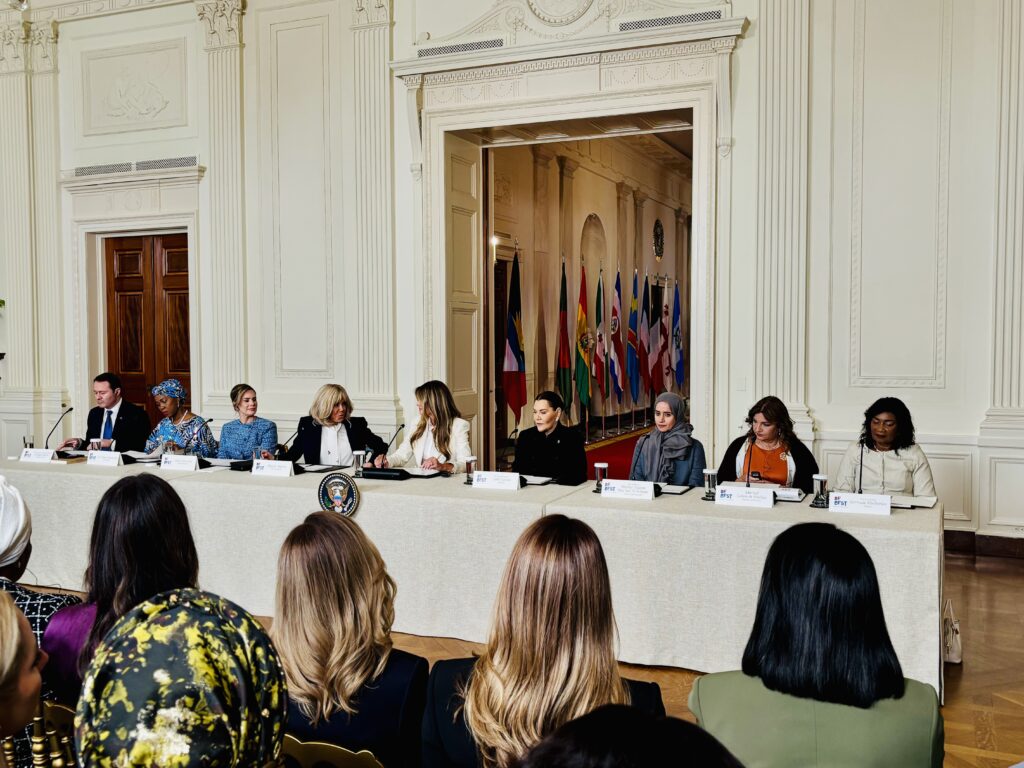
In March, Mrs. Trump convened first ladies and first spouses from more than 40 countries for a two-day conference hosted at the State Department and the White House to discuss how governments can empower and protect children and youth in the age of AI.
RELATED:
The discussions reflected a growing global consensus that AI presents both extraordinary opportunities and significant risks. Participants examined ways to expand access to digital education and skills training while also addressing concerns surrounding online safety, misinformation, digital exploitation and the responsible use of emerging technologies.
Africa was strongly represented at the gathering, highlighting the continent’s growing focus on digital transformation and youth development. First ladies from countries including Sierra Leone, Kenya, The Gambia, Nigeria, Ghana, Malawi, Morocco and Seychelles shared initiatives aimed at expanding educational opportunities, promoting digital literacy and supporting young people through their respective foundations and national programs.
The White House event offers a glimpse into the future workforce that will shape how artificial intelligence is developed, governed and deployed in the decades ahead and serves as a reminder that the global competition for technological leadership increasingly begins in the classroom. But it also reflects a broader debate over how societies can harness the benefits of artificial intelligence while minimizing its risks.