
Kemi Osukoya | WORLD BRIEFS & POLICY
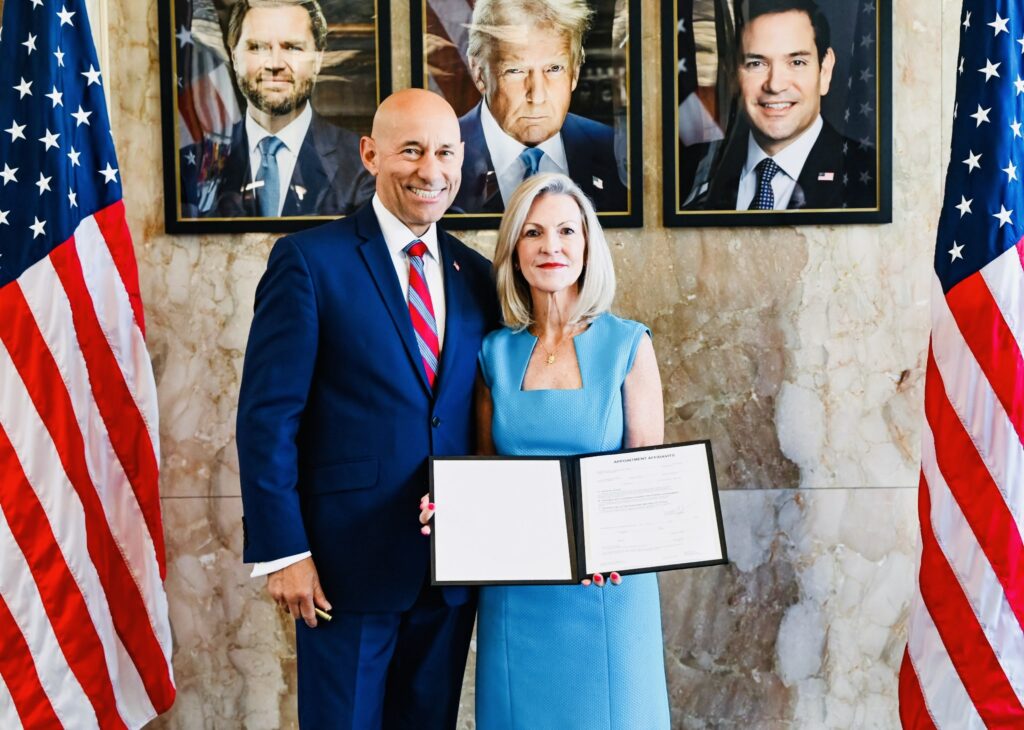
Frank William Garcia Jr. has been sworn in as Assistant Secretary of State for African Affairs, assuming one of Washington’s most consequential foreign policy roles at a time when U.S.-Africa relations are undergoing significant recalibration.
A former U.S. Navy captain, Garcia brings more than two decades of experience working on issues in Africa, national security, and intelligence. Before being nominated for his new role by President Donald Trump, he served as a senior adviser to the U.S. House Permanent Select Committee on Intelligence and held several other senior roles on the Committee, building a reputation as one of Washington’s most experienced Africa policy hands.
His appointment comes as the Trump administration underscores commercial diplomacy, trade, and investment as the foundation of its Africa strategic competition rather than traditional development assistance. Garcia has signaled that he intends to advance that agenda while strengthening mutually beneficial partnerships between the U.S. and African countries.
The timing couldn’t be more than important.
He takes the reins at the State Department as America’s approach to Africa continues to evolve amid intensifying geopolitical competition, particularly with China, whose footprint across the continent spans infrastructure financing, trade and investment. At the same time, the administration’s reworked global health strategy is being tested on the ground as East Africa grapples with the effects of recent Ebola outbreaks in the Democratic Republic of Congo, and Uganda.
Garcia’s extensive intelligence background is also expected to be an asset for the Administration as it seeks to balance its commercial ambitions with longstanding security priorities across the continent.
While trade and investment have become increasingly central to U.S. engagement, security concerns remain deeply intertwined with economic objectives, especially on threats posed by al-Shabaab in East Africa to extremist groups operating across the Sahel, ISIS affiliates Boko Haram in West Africa and growing instability in parts of Central Africa, the U.S. continues to view counterterrorism cooperation as a critical component of its Africa strategy.
His experience navigating the intersection of security and foreign policy positioned him to help align the Administration’s diplomatic, economic and security priorities across the continent at a time when U.S. policymakers increasingly recognize that investment and infrastructure projects cannot flourish without a stable security environment.
For many African governments, U.S.’s growing emphasis on commercial diplomacy has been broadly welcomed. Across the continent, leaders are increasingly prioritizing economic growth, industrialization, infrastructure development and job creation, and are seeking greater access to capital and private sector investment rather than relying solely on traditional aid programs.
On the flip side of the coin, Garcia inherits a complex policy landscape.
One of his immediate challenges would be addressing what many African policymakers view as mixed signals from the Trump Administration. While administration officials have emphasized trade, investment and economic partnerships, concerns remain over immigration policies, visa restrictions and broader questions about long-term U.S. commitment to the continent.
Delivering a coherent message will be critical, former diplomats, and American business executives, including former Ambassador Troy Fitrell, told Africa Bazaar during several interviews. African governments and investors increasingly want clarity not only on Washington’s strategic intentions but also on how the administration intends to translate its trade and investment agenda into measurable outcomes. For Garcia, credibility and execution may ultimately matter more than rhetoric.
He will also need to deepen engagement with African diplomatic partners in Washington and beyond as well as regional institutions, a process that has already begun. Sustained dialogue will be necessary to reassure governments that the Administration’s renewed commercial focus is intended to complement, rather than replace, broader diplomatic and security cooperation.
Garcia was confirmed by the full Senate after a closely watched confirmation process. During his hearing, he highlighted the Lobito Corridor as an example of the type of economic partnership model the administration hopes to expand across Africa.
The Lobito Corridor has emerged as one of the most strategically significant infrastructure projects on the continent. Originally launched as a flagship G7-backed initiative, the project seeks to modernize and expand an approximately 810-mile rail and transport network linking Angola’s Atlantic port of Lobito with the mineral-rich regions of the DRC and Zambia, while strengthening broader connectivity toward East Africa through Tanzania and Uganda.
The corridor is designed to accelerate the movement of copper, cobalt and other critical minerals as well as agricultural products from Central and East Africa to global markets, placing it at the center of growing international competition for resources essential to electric vehicles, battery manufacturing and clean energy technologies.
For the U.S., the project represents more than infrastructure. It has become a test case for a new model of engagement that combines public and private capital, strategic investment and commercial partnerships as an alternative to state-led financing approaches that have helped China expand its influence across the continent.
Whether that model can be successfully scaled across Africa may become one of the defining questions of Garcia’s tenure as well as demonstrating that America’s renewed focus on commercial diplomacy can deliver tangible economic results while strengthening the security partnerships, diplomatic relationships and strategic trust that continue to underpin U.S.-Africa relations.
As African economies seek new sources of growth and global powers compete for influence across the continent, the newly confirmed Assistant Secretary enters office at a moment when expectations are rising on both sides of the Atlantic. His challenge will be