
By Kemi Osukoya | Global Finance & Monetary Policy
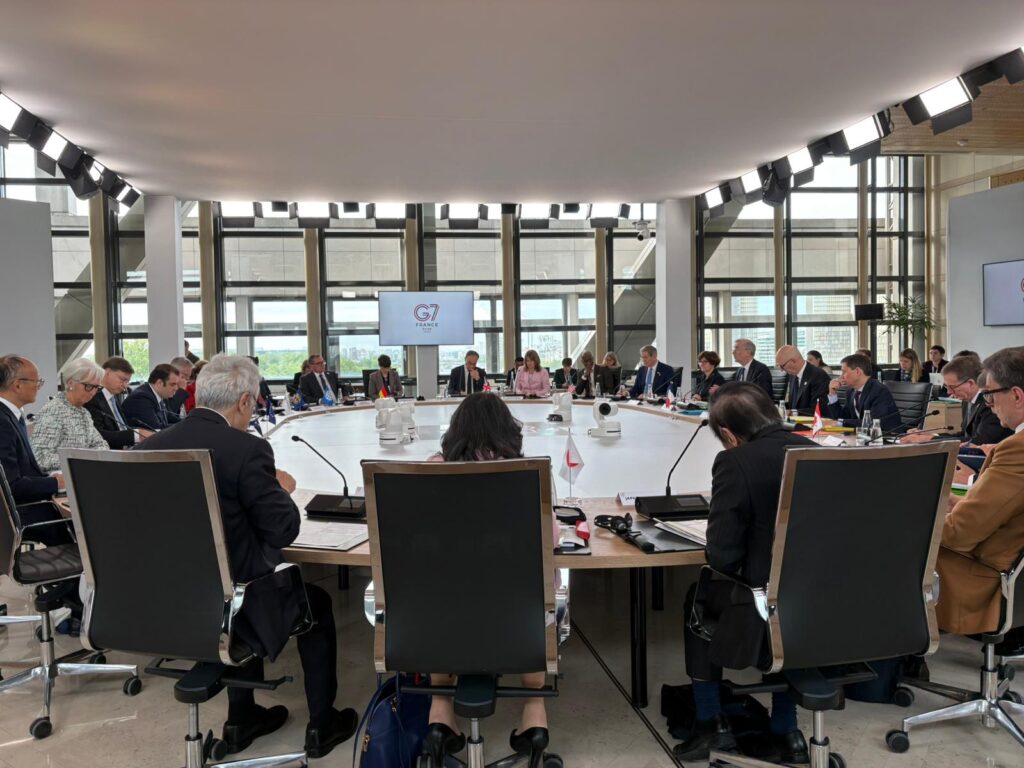
Finance ministers and monetary policymakers from the world’s top seven biggest economies emerged on Tuesday from closed-door G-7 talks in Paris warning that a new era of geopolitical fragmentation — from Middle East tensions to supply-chain vulnerabilities and widening economic imbalances — is reshaping the architecture of the global economy and forcing governments to rethink how they coordinate growth, trade and financial stability.
The meetings, led by French Finance Minister Roland Lescure and Central Bank Governor François Villeroy de Galhau, underscored how economic policymaking is increasingly being driven by security concerns, from critical minerals and energy flows to cyber threats and cross-border payments infrastructure.
The French officials framed the two-day discussions as a crucial staging ground ahead of next month’s G7 Leaders’ summit in Evian, France, where heads of state are expected to push for coordinated action on global imbalances, strategic dependencies and support for vulnerable economies caught in the fallout from the Middle East conflict.
This year’s finance agenda also reflected the growing influence of the Global South within the international financial system. Brazil, India, Kenya, and South Korea participated in parts of the discussions for the first time, signaling that emerging economies are becoming increasingly central to debates over capital flows, digital finance, trade corridors, commodity supply chains, and monetary stability.
The inclusion of Kenya and India in particular highlighted the rising importance of emerging-market payment ecosystems and fintech innovation in shaping the next phase of global finance. Kenya has become synonymous with Africa’s mobile-money revolution through its M-Pesa payment system, while policymakers have increasingly viewed India’s digital public infrastructure and instant payments architecture as models for scaling low-cost financial inclusion across developing economies. Brazil and South Korea, meanwhile, have become key players in discussions surrounding industrial policy, digital currencies, semiconductors and critical minerals supply chains.
“I would just like to reiterate that this was an important, very important, extremely important meeting, addressing the major economic challenge of the 21st century,” Lescure said during a press conference at the close of the ministerial gathering. “In the face of geopolitical events, in the face of economic imbalances, in the face of our dependencies, multilateralism is not an ideal, it’s not an option. It’s the most powerful tool.”
The remarks echoed warnings raised last week in Washington during the IMF press briefing, where official pointed to rising geopolitical fragmentation, trade distortions, and supply shocks as mounting risks to global growth. The Fund has increasingly argued that coordinated policy responses, rather than unilateral tariffs or fragmented industrial strategies, will determine whether the world economy avoids a prolonged period of structurally slower growth and persistently higher inflation.
French officials sought to position this week’s G7 talks as an effort to move beyond broad diplomatic language toward what Villeroy de Galhau described as “pragmatic multilateralism” a tangible cooperation on economic security issues already affecting households and businesses.
“Cross-border payments are too slow, too expensive at present,” Villeroy de Galhau told reporters. “We decided to accelerate the interlinking of our fast payment systems and adopted common values and prepared a practical handbook. We should make cross-border payments definitely quicker, cheaper and safer.”
The focus on payments infrastructure reflects a wider push among central banks to modernize the global financial system as digital payments, and other digital asset technologies begin reshaping cross-border commerce.
That shift was reinforced earlier this month in Dakar, Senegal, where Fed’s Governor Lisa Cook said that digital assets such as tokenization could fundamentally reshape financial markets by reducing frictions in cross-border transactions, expanding access to capital markets and improving liquidity management, especially in emerging economies. Speaking at a conference hosted by the Central Bank of West African States, Cook said innovations such as blockchain-based settlement systems and programmable financial contracts could offer “compelling benefits” for Africa and other developing regions, including “potentially faster cross-border payments and better access to capital markets.”
Cook, who studied at Dakar’s Cheikh Anta Diop University before entering economics, linked today’s digital-finance debate to Africa’s earlier fintech transformation led by mobile money systems such as M-Pesa in East Africa. She said those innovations piqued her interest in technologies that facilitate faster movement of capital and payments, while arguing that tokenization could become the next major evolution in global finance.
Her remarks align with a broader shift now taking place among major central banks and multilateral financial institutions as monetary policymakers increasingly view payment systems, tokenized assets and digital infrastructure not simply as financial innovations, but as strategic components of economic resilience and geopolitical influence.
The G7 discussions also centered heavily on critical minerals and energy security, areas that have become increasingly entangled with industrial policy and national security concerns. Lescure said governments were exploring new frameworks to monitor supply chains for rare earths and strategic materials essential for electric vehicles, batteries and advanced technologies.
“The nexus between food security, energy security, economic security and national security has never been clearer,” Canadian finance minister Francois Philippe Champagne said Tuesday during an appearance on Canada’s Cable Public Affairs Channel, describing critical minerals as “top of mind” across nearly every G7 discussion.
French officials argued that advanced economies must coordinate more closely to avoid dangerous supply dependencies, particularly in sectors dominated by a single producer. Lescure pointed to a new rare earth recycling and production facility in southwestern France backed by investors from the U.S., Japan and France as an example of what he described as “multilateralism on the ground.”
“We are showing on the ground that we can produce alternatives to a market where today one country has a monopoly,” he said.
The G7 ministerial discussions took place against the backdrop of heightened concern over the economic consequences of the Middle East conflict and the continued disruption surrounding the Strait of Hormuz, a critical artery for global energy shipments.
“We all believe it must end as quickly as possible,” Lescure said of the conflict. “The sooner the Strait of Hormuz is reopened, the sooner this economic bottleneck created by a geopolitical conflict is resolved, the better off we will all be.”
His comments echoed warnings from other global leaders as negotiations led by Egypt, Pakistan and several Gulf and Arab states continued behind the scenes in an effort to end the conflict and reopen the Strait. President Donald Trump earlier this week said he had suspended further military action against Iran after regional stakeholders urged him to allow more time for diplomacy, framing the pause as an opportunity to finalize a broader agreement tied to restoring safe maritime passage through the Strait.
At the same time, G7 officials made clear they intended to maintain pressure on Russia and prevent Moscow from benefiting financially from higher energy prices triggered by regional instability.
“Russia cannot benefit from the war in the Middle East,” Lescure said. “This is not an option, and on this, all G7 members agree.”
The minister said the group remained united behind support for Ukraine, including efforts to close Kyiv’s financing gap and fund repairs to the Chernobyl confinement structure.
Beyond the geopolitical tensions, the ministers and central bankers acknowledged growing anxiety over inflation, sovereign debt markets and the economic effects of what Villeroy de Galhau described as two simultaneous global supply shocks: rising energy disruptions and the rapid expansion of artificial intelligence.
“We discussed the increasing uncertainty increased by the ongoing conflict in the Middle East,” he told reporters. “It heightened risks to both growth and inflation.”
Central bankers reaffirmed their commitment to keeping inflation anchored while warning that monetary policy would remain data dependent amid heightened market volatility.
“The main question is not about the date, it’s about data,” Villeroy de Galhau said, referring to speculation around future interest-rate decisions.
The Paris meetings also highlighted a broader debate emerging inside the G7 over how to correct widening global economic imbalances without escalating trade fragmentation. Lescure argued that structural weaknesses across major economies require coordinated adjustments rather than unilateral action.
“Europe needs more investment. China needs more consumption. The U.S. deficit needs to go down,” he said. “If each of us does the right thing, we will all together be better off.”
Still, divisions remain, particularly over trade policy. Lescure openly acknowledged disagreements with Washington over tariffs, even as he defended the broader value of cooperation.
“I disagree with him on the use of tariffs to correct global imbalances,” he said, referring to U.S. Treasury Secretary Scott Bessent. “But once those disagreements are acknowledged, our collective ability to find areas where we can agree, move forward together and sometimes persuade one another is obviously welcome.”
“The law of the fittest just doesn’t work,” Lescure said. “We’re ending this with a shared commitment to build a more stable, more resilient and fairer global economy.”