
By Kemi Osukoya
MARKETS & POLICY
In Washington, a quiet but far-reaching shift is taking hold—one that could reshape not just how America farms, but how the world thinks about food.
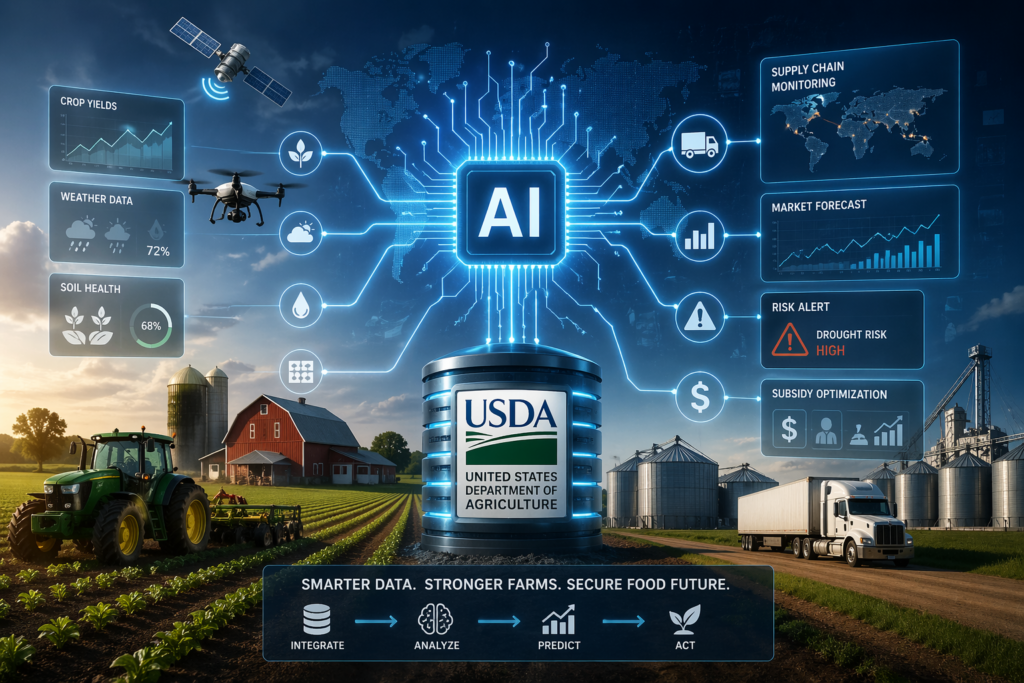
The U.S. Department of Agriculture is being rewired around artificial intelligence, part of a broader push by the Trump Administration to embed data-driven systems across government. The change is less visible than sweeping policy reforms but potentially more consequential. Agriculture, long shaped by uncertainty, delayed reporting and reactive policy is being recast as something closer to a real-time, predictive data-led system.
The effects won’t show up overnight. Grocery bills aren’t about to fall. But over the next several years, officials are betting the technology will mean fewer sudden price spikes, fewer empty shelves and a supply chain that anticipates disruption rather than scrambling to respond to it.
At the center of it is a $300 million deal with Palantir Technologies, which will provide software to integrate and analyze vast amount of agricultural data. The goal: unify fragmented systems tracking—from farmland ownership to crop yields to logistics and supply chain risks—into a single, AI powered platform that forecast production, target subsidies and detect shocks before they ripple through markets.
In effect, the U.S. is building a real-time operating system for agriculture.
Yet for all the talk of artificial intelligence, the more immediate task is more foundational: stitching together decades-old silos.
“The USDA-Palantir contract is about centralization of USDA databases across its numerous agencies,” Joseph W. Glauber, a Research Fellow Emeritus at International Food Policy Research Institute, who spent three decades at the USDA department, including as chief economist tells Africa Bazaar. “For most of the time, I was there, the Department talked about integrating administrative data from the Farm Service Agency, the Risk Management Agency, the Natural Resource Conservation Service and the National Agricultural Statistics Service.”
Those systems, he notes, were historically “stand alone,” making it “very cumbersome to crosscheck data across agencies.” The result was duplication, delays and blind spots in policymaking. “My understanding is that Palantir will help integrate this data, some of this is for compliance purposes to ensure farmers who receive program payments are providing accurate data, but it also [helps] streamline data collection.”
This streamlining is happening against a backdrop of mounting pressure. American farmers are grappling with rising input costs, trade tensions with major partners such as China, and the knock-on effects of geopolitical conflicts that have driven up energy and fertilizer prices. A $12 billion federal bailout provided to farmers last year has cushioned some of the blow, but volatility remains a defining feature of the sector. At the same time, concerns over foreign ownership of farmland have elevated agriculture into the realm of national security.
That reframing of food as a part of national security is critical. Food is no longer treated simply as an economic output, it is increasingly viewed as strategic infrastructure. The USDA’s “One Farmer, One File” initiative aims to consolidate fragmented databases, reduces bureaucracy and provides policymakers with a real-time view of the food system. For farmers, it means faster payments and less paperwork. For government, it means earlier intervention and more precise decision-making.
For Palantir, the deal marks a continued expansion beyond its defense roots into the machinery of civilian governance. Under chief executive Alex Karp, the company has positioned itself as a builder of digital infrastructure for the modern state, systems designed not just to process data, but to share strategic outcomes.
But the real story lies beyond the U.S.—and here, the narrative is more nuanced than the usual fears of technological dominance.
Better U.S. data, Glauber argues, does not necessarily translate into concentrated power. “Better U.S. data will improve forecasts, which are all publicly available. This is a global public good,” he says, pointing to the original rationale behind the USDA’s creation in 1862. “Without public information, markets can be easily manipulated.”
Indeed, while institutions such as the Food and Agriculture Organization, the World Bank Group and the World Trade Organization produce their own agriculture estimates, USDA remains, Glauber argues, “the gold standard”—a benchmark that global markets, traders and governments rely on.
That has important implications for emerging markets. Improved data forecasting could, in theory reduce the severity of global food crisis. “Yes, improving market data can help forecast food crises in a more accurate and timely fashion,” he says in response to question on whether this AI-driven system will lessen global food insecurity. “Since the data are openly available to the public, all countries benefit.”
This cuts against a more alarmist view that AI-driven agriculture will create a two-tier global trading system, one that pit advanced countries against developing countries. “I don’t think so,” Glauber says skeptically before noting that global trade governance and agricultural data systems already operate in parallel but interconnected ecosystems. The WTO tracks trade measures—tariffs, subsidies, while production and price data are compiled by a network of international organizations that work closely with the U.S.
Nor does he see the rise of AI in agriculture as a precursor to the weaponization of food. “No, I think this concern is unfounded,” he replies. “AI is a technology that holds much promise for price forecasting,” pointing to ongoing collaborations between institutions such as the International Grains Council and the WTO, as well as advances in real-time monitoring—from maritime trade tracking to earth observation platforms identifying early warning signals for drought.
Still, the geopolitical undertones are hard to ignore.
If the U.S. succeeds in building a real-time, AI-enabled agricultural system, food industry experts and commodity market analysts tell Africa Bazaar, underscoring the “if it succeeds,” it will set a new benchmark—technological, institutional and strategic. For Africa, where agriculture remains both an economic backbone and a structural vulnerability, the implications are double-edged.
One one hand, they say, the democratization of high-quality data, if it remains open, could strengthen food security, improve crisis response and support more efficient regional trade under frameworks such as the African Continental free Trade Area. On the other, the capacity to act on that data, to build predictive systems, integrate supply chains and deploy capital at scale remains uneven.
While those results may not be a closed two-tier system, it a more subtle divergence: between countries that can translate data into action and those that cannot.
They note the shift will take time to materialize. Infrastructure must be built, system integrated and trust established; even the most advanced models will remain vulnerable to climate shocks, energy shocks and human constraints.
However, despite their reservations due to a lack of enough research information about the deal, they say the direction is unmistakable: The future of agriculture points to a future where the stability of global food systems and the balance of power behind them will increasingly hinge not just on who owns the data, but on how effectively it is shared, trusted and used.