
By Kemi Osukoya | MARKETS & FINANCE Updated 8:45 p.m. ET April 29, 2026
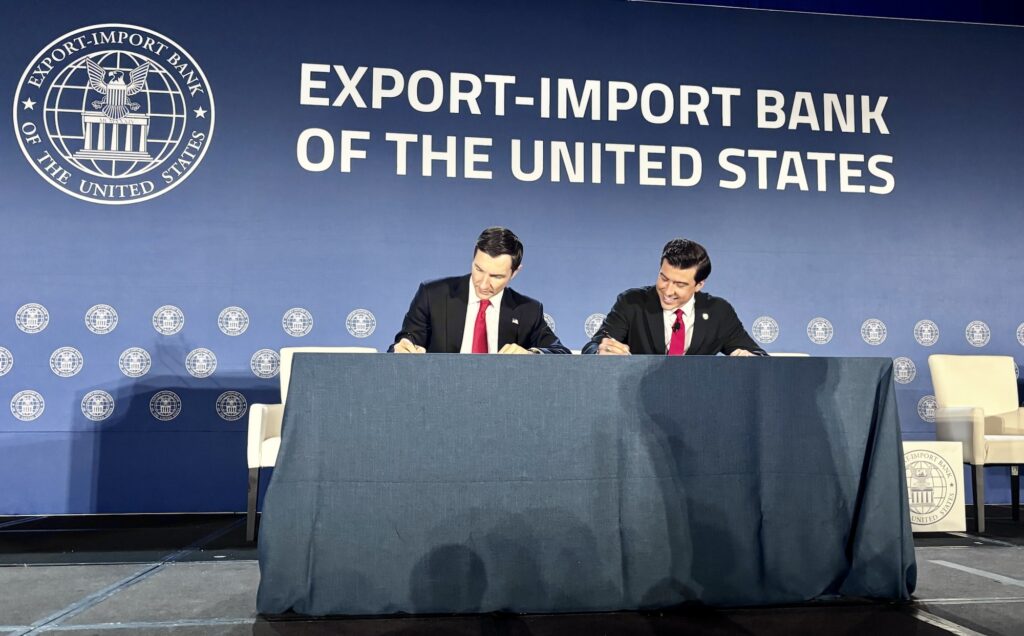
It started, as surprising as many of policy does nowadays, with a social media post.
When Luke Lindberg was tapped a year ago to take on the U.S. Department of Agriculture‘s top trade role as Under Secretary of Trade and Foreign Affairs, he remembers the line that came with it from President Donald Trump: “Who’s going to go out and get smart trade deals for America’s farmers and ranchers?”
A year on, he’s answering that question posed by the President. “Well, I’m pleased to report today that we have not only begun that process, but really we have made a historic advancement on that exact task,” he told a business executive audience at the U.S. EXIM Bank conference on Wednesday.
That arc—from directive to delivery—now lands in something more tangible: a formalized partnership between the USDA and the U.S. Export-Import Bank, and the launch of the Financial Assurance to Revitalize Markets, or FARM, Initiative.
In Washington, policy is increasingly written in the language of capital—credit, risk guarantees, and nowhere is that more evident than here. What is being rolled out is less a program tweak than a coordinated attempt to rewire how American agricultural goods move through the global system.
If the administration’s first phase was about negotiating access, this phase is about usability—ensuring that once markets open, they can actually transact.
“It’s not okay for us to open up new markets all around the world, and then for them to say, sorry, we signed this trade agreement, but we cannot actually purchase your products because we don’t have the financing we need,” Lindberg said.
At the center is an overhaul of the USDA’s GSM-102 export credit guarantee program, a decade-old tool that quietly underpins U.S. farm exports. Under FARM, the program becomes more elastic: an 18-month “bullet” repayment option, globalized banking participation, and in higher-risk markets, guarantees lifted to 100 percent.
“What that does is take our GSM 102 program, and it opens it up to new regions and new markets in three important ways,” Lindberg said, with the objective to “give no excuses for folks that want to buy American to have the opportunity to do that.”
The financing push comes amid a sharp reversal in the U.S. agricultural trade balance. Lindberg pointed to a $50 billion deficit when Trump returned to office—“very outside of the historic norms for U.S. agriculture”—and said the gap has since narrowed.
“That is a 42 percent reduction in the trade deficit in one single year,” he said
For Secretary of Agriculture Brooke Rollins, the shift is as much philosophical as it is financial. “Since January 20, 2025, President Trump has initiated the most aggressive foreign trade agenda in American history,” she said. “This new partnership between USDA and EXIM is exactly the new thinking needed to fully utilize every single available resource to boost ag exports, improve the ag economy and return to an ear of long-term stability and profitability in rural America.”
That “new thinking” hinges on higher alignment with the Export-Import Bank, which will layer its own credit insurance and financing tools onto USDA guarantees, expanding both scale and reach.
“American agriculture is a foundation of our national strength and for too long, U.S. producers were forced to compete on an uneven playing field,” said U. S. EXIM Bank Chairman John Jovanovic. “By pairing EXIM’s export criteria tools with USDA’s GSM-102 program guarantees, we’re delivering a stronger, more coordinated approach to export financing, reducing risk, opening new markets, and putting more American-grown products in the hands of buyers worldwide.”
The result is a larger tool of state-backed capital aimed squarely at one constraint: not demand, but liquidity, particularly in emerging markets such as those in Africa, Asia and Latin America —where buyers often lack access to affordable credit.
Yet, financing layer is only half the story.
Running in parallel is a quieter structural shift inside USDA itself. As reported by Africa Bazaar, in a previous move, the department struck a $300 million deal with Palantir to build out AI-driven infrastructure designed to anticipate supply shocks, model demand, and guide decision-making across the agricultural system.
Taken together, the direction is clear: one track builds foresight, the other builds execution. Data to predict where the world will need food; financing to ensure American farmers and producers can meet that demand when it materializes.
Lindberg describes the operational side in more immediate terms. “We want to show up in that market within three months and start making deals happen, real sales contracts that bring real dollars back to rural America,” he said, referring to a series of rapid-response trade missions tied to newly signed MO agreements.
It amounts to a more engineered model of agricultural trade—less reactive, more constructed.
Or as he put it: “This going to put the wind at the back of the sails of our farmers and ranchers and we are going to win.”
This article has been updated