
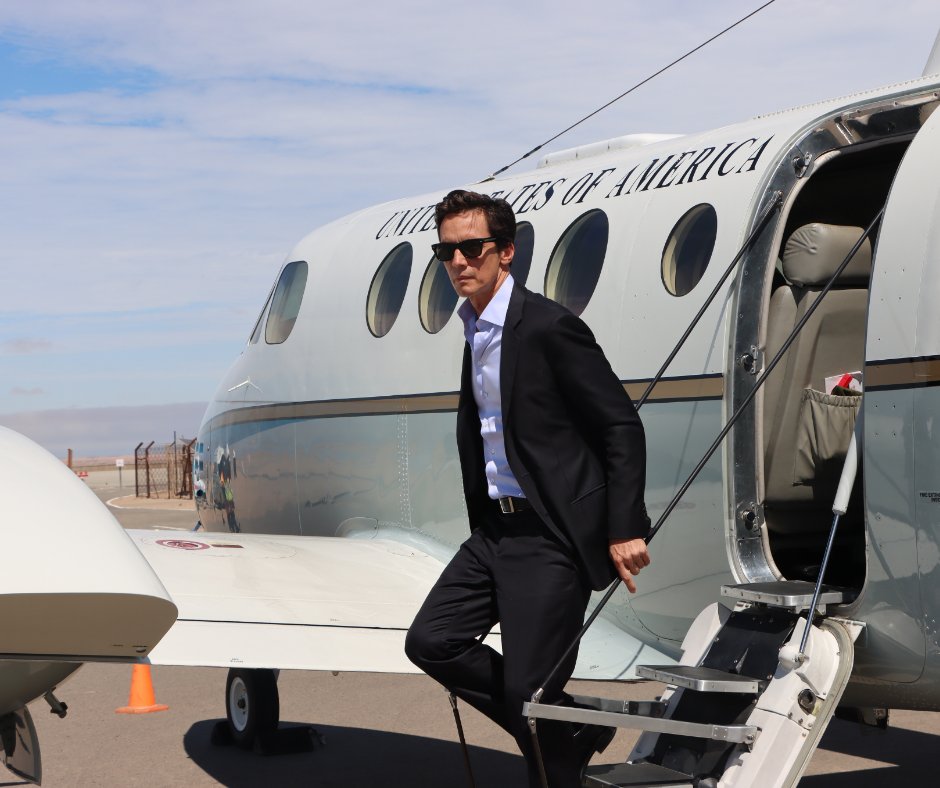
From Walvis Bay to Washington, the U.S. and Namibia are building a shared investment agenda around logistics, energy, critical minerals—and the business of creating jobs.
By Kemi Osukoya | BUSINESS & INSIDE AFRICA
Some roads take you to a destination, while others change the way you see the journey –and where you are headed.
America has Route 66, the Mother Road: that storied stretch of highway that once carried families, freight, dreamers, dust-covered Chevrolets and an entire nation’s restless appetite for the next horizon. It is a road with its own mythology, remembered in songs and films, where the journey was never only about getting from Chicago to Los Angeles but about becoming something larger along the way.
Namibia has its own version of that feeling.
Not Route 66 exactly. Namibia roads are quieter, more elemental and, in places, so breathtakingly beautiful that you begin to wonder whether the land has been left untouched by time or whether time itself has simply slowed down to respect it as you move through sculpted deserts the color of fire, past granite mountains and long, endless stretches of horizon where the skies seem to have been given more room than it has anywhere else.
They do not connect neon diners and roadside motels. They connect mines, farms, towns, borders and ports. They run west toward Walvis Bay, Namibia’s deep-water commercial port on the Atlantic, and east and north toward the landlocked markets of southern Africa: Botswana, Zambia, Angola, South Africa, Zimbabwe and, potentially, beyond.
At first glance, they are just roads. But in a country with some of the world’s most sought-after minerals, offshore oil and gas discoveries, immense renewable-energy potential and an Atlantic port that could reshape trade routes across Southern Africa, they are something more.
They are an invitation.
And it is an invitation that President Donald J. Trump and his Administration are beginning to take more seriously.
The emerging story between Washington and Windhoek is not simply about foreign aid, although decades of American investment in health, education and democratic institutions remain an important part of the relationship. It is increasingly about business: trade, investment, energy security, critical minerals, logistics, processing capacity and the possibility of building industries that can create jobs and wealth within Namibia, rather than merely move raw materials out of it.
“Think of Namibia as a node in this corridor,” John Giordano, U.S. Ambassador to Namibia told me last week during an interview, sketching Namibia’s map within Southern Africa across the conference table in our Washington D.C. office. “Resources create opportunity. It’s the systems that are going to create value.”
That statement, in a nutshell, gets to the heart of what is at stake.
The minerals are there. Namibia is already one of the world’s leading uranium producers and has deposits of lithium, rare earths and diamonds. Oil and gas discoveries offshore have transformed the country into one of the more closely watched energy stories on the continent and in the world. The country’s sun and wind have made it a natural contender in the global race for renewable energy and green hydrogen.
But minerals, oil, sunlight, and ocean access do not automatically make a country prosperous. If they did, Africa would long ago have been the world’s wealthiest continent.
What creates value is what happens around the resource: the roads, railways, ports, warehouses, power plants, financing mechanisms, regulatory certainty, training programs, processing facilities, and local enterprises. In other words, the work above ground is every bit as important as what is below it.
That is the commercial proposition now taking shape between Washington and Windhoek.
From Traditional Aid Platform to Business Platform
Giordano arrived in Windhoek last October as the first politically appointed U.S. ambassador to Namibia. All prior U.S. ambassadors to the country were career diplomats. He was also the first ambassador appointed under the second Trump Administration to arrive at his post on the African continent. He describes his arrival in a way that sounds less like a diplomat settling into a residence and more like an entrepreneur walking into a company in need of a reset.
“When I arrived, it was very much a reboot of the embassy. It almost felt as though I had to look at it as a startup,” he told me.
The question he said he asked himself was how to renew and reinvigorate the U.S.-Namibia relationship, particularly through commercial diplomacy.
“It was an aid platform,” Giordano said of the U.S. approach in the past. “I grabbed hold of it and very quickly transitioned it to a business platform.”
That transition is part of a broader recalibration in Washington and at the White House. President Trump and his administration have made no secret of their preference for trade and investment over traditional development assistance. For African countries and leaders, that shift has been a welcome relief as it presents an opening for more serious private-sector engagement and greater access to American capital, technology and markets.
Namibia’s Ambassador to the U.S., Honorable Wilbard Hellao, sees the change as an opportunity.
“The focus here is more on transactions,” Hellao told me during an interview at the Namibia Embassy in Washington. “They [the Trump Administration] want to move away, or migrate, from development aid into what we call economic transactions, trade and investment, and we approve of that.”
That does not mean Namibia is turning its back on development cooperation. Far from it. The country has benefited from long-standing U.S. investment in health, education, and institution-building. But Hellao’s point, and Giordano’s, is that the relationship is ready to grow up.
In other words, aid can build a foundation. Investment can build an economy.
The Trump administration’s pivot to commercial diplomacy also comes at a moment when Africa is no longer a place the world can afford to view through old clichés about risk, poverty and instability. Those views have not only been incomplete; they have cost American businesses time, influence and opportunity.
For years, China saw what much of the Western world was too distracted, skeptical, or slow-moving to see: a continent with fast-growing cities, young populations, rising consumer markets, strategic minerals and a huge infrastructure gap that could become a commercial opening for anyone willing to show up early and stay patient.
China showed up.
It financed roads, railways, ports, power projects, industrial parks, telecommunications infrastructure, and mines. It entered markets others viewed as too difficult. In the process, it developed trade relationships and political influence across the continent that the U.S. is now working to match, recalibrate or, in some areas, challenge.
The question African leaders and the diaspora are now asking the U.S. is not whether it would compete with China in Africa. It already is. The real question is whether it can offer something different: financing that is commercially sound, partnerships that create local skills and jobs, and projects that remain valuable long after the ribbon-cutting ceremony.
That is where Namibia becomes an interesting case study that provides a window into what the next stage of the U.S.-Africa partnership looks like.
The Trump Administration last month announced $500 million in funding, through grants that would be given to 10 individuals in the amount of $5 million to $55 million as part of its U.S.—Africa strategic investment program for projects in the critical minerals supply chain in sub-Saharan Africa.
Walvis Bay and the Bigger Map
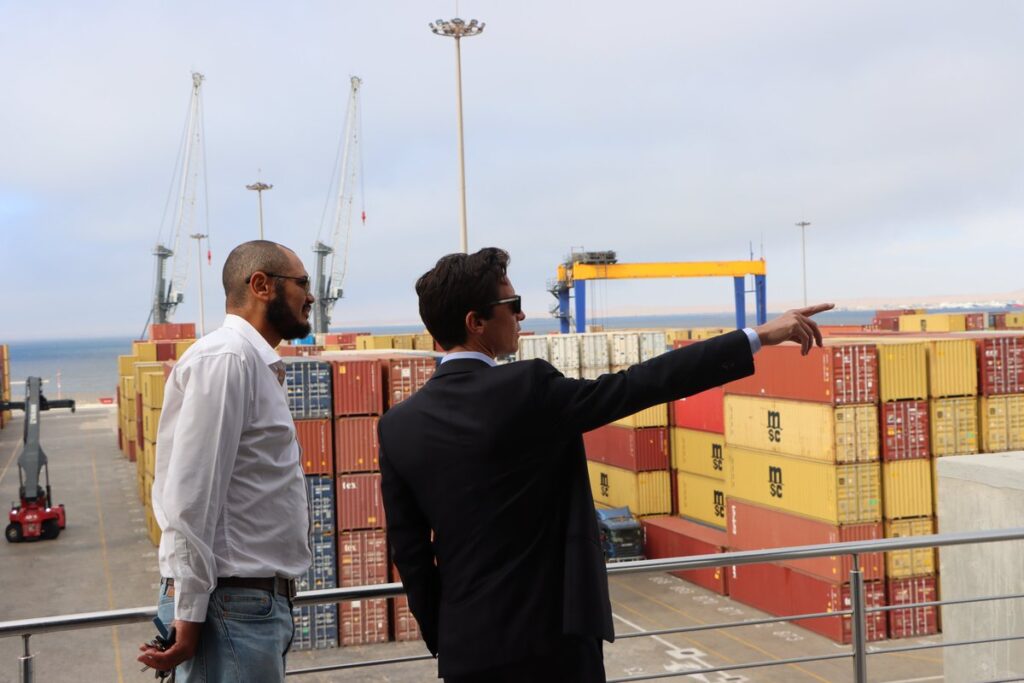
“People were blown away,” Giordano said, describing his conversations with American top business executives. “They’d say, ‘Wait, there’s oil off the coast? There’s a deep-water port there? Namibia is the world’s third-largest producer of uranium?'”
That surprise says as much about American awareness of Africa as it does about Namibia’s potential.
Walvis Bay is central to the story. Situated on Namibia’s Atlantic coast, it is the country’s principal port and a gateway not only for Namibia but for countries farther inland. The port’s strategic appeal lies in its geography: it can connect the mineral-rich interior of southern Africa to international markets through a western outlet on the Atlantic.
“It’s going to be complementary,” Giordano said when I asked whether Walvis Bay could become part of a new energy and commercial corridor alongside the U.S.-backed Lobito Corridor farther north. “It’s that port at Walvis Bay, and everything they are building above the ground, that’s what’s going to get everything out into market.”
Hellao makes the case in equally direct terms. “Namibia is a logistics hub, we are serving all of our landlocked countries,” he told me.
That is more than an exercise in national branding.
A better-connected Walvis Bay can serve mines and manufacturers in Namibia, but it can also help move goods for Botswana, Zambia and other landlocked economies to the global market. It can support offshore oil and gas services, critical-mineral supply chains, agricultural exports, warehousing, cold storage and transport businesses. It can create a commercial ecosystem around movement, just as the great trade routes of the world always have.
Think of it as Route 66 with a port at the end of it, except this time the road does not lead to a postcard version of the American West. It leads to a global energy market and supply chain.
And that energy market and supply chain matter now more than ever in a world of geopolitical and geoeconomic uncertainties.
Amid global uncertainties and repeated shocks, world leaders are seeking alternatives and additions to existing sources of energy security and critical minerals, as underscored at this year’s G7 Leaders’ Summit in Evian, France. Some of them are looking for reliable uranium as countries reconsider nuclear energy in the face of rising electricity demand. Some are looking for energy, new oil and gas frontiers, renewable-energy projects, and better routes through which all of these commodities can move.
Namibia sits in the middle of that conversation, though it has not always been loud about it.
De-Risking the Future
Of course, promise is not the same thing as investment.
For American companies and investors who often are risked adversed when it comes to Africa, the first question is not whether Namibia has resources or potential, it is whether the risks can be understood, managed and financed.
Frontier markets can be rich in opportunities, but they also require capital willing to be patient and institutions willing to help companies bridge the gap between a promising presentation and a project that can actually be built.
Giordano understands their trepidations and believes the U.S. government has the financial tools that can make that distance shorter.
He points to the U.S. Development Finance Corporation, the Export-Import Bank and the U.S. Trade and Development Agency as institutions that can help American companies with financing, insurance, guarantees and feasibility studies.
“When they see the United States government through these very formidable tools come in and say, ‘Okay, well, we’re going to invest alongside you,’ that really de-risks,” he told me enthusiastically. “That provides confidence.”
This kind of financing may not have the glamour of a new oil discovery or a billion-dollar announcement, but it is often the difference between a project that remains a talking point and one that begins hiring people.
Over $30 billion have been approved for critical mineral projects across the world in the last 18 months, including the Lobito Corridor and other projects in Africa.
The DFC—which provided the initial funds needed to catalyze capital for the Lobito Corridor—can provide project finance, political-risk insurance and guarantees. The EXIM Bank can help finance American exports and support U.S. companies doing business abroad. USTDA can help prepare projects before investors make large commitments. Together, these institutions give American firms a more practical path into markets where the opportunities are real but the early-stage risk can be intimidating.
That matters in Namibia, where private-sector discussions are already taking place in energy, logistics, infrastructure and critical minerals. The companies involved have not yet been publicly named, largely because early-stage commercial activity is necessarily sensitive. Projects of this scale tend to move quietly at first. They emerge only after financing is secured, agreements are signed and the long internal work of assessing risk has been done.
“The hope was to attract business and let that snowball and that’s exactly what is happening. Folks are now calling us. They want to talk about opportunities they have heard about,” Giordano told me, leaning back in his chair with the satisfied smile of someone who has uncovered a hidden treasure and is now eager to share it.
When I asked, Ambassador Hellao confirmed there are now significant interests from the American private sector with ongoing discussions in various sectors, though he, like Giordano, would not give me any details due to the ongoing negotiations. But he said the Embassy has seen a significant increase in visa applications,—more than 45 percent from Americans—both business and tourist visas over the last 8 months, compared to previous years.
In fact as I prepare this article for publication and await official data from U.S. officials in Washington D.C., a delegation of U.S. government officials from the U.S. Department of Energy and USTDA, along with American business executives, and investors are on the ground in Namibia attending a Mining Expo event where Namibia’s President Netumbo Nandi-Ndaitwah–the first woman to be elected into that post, delivered a keynote speech.
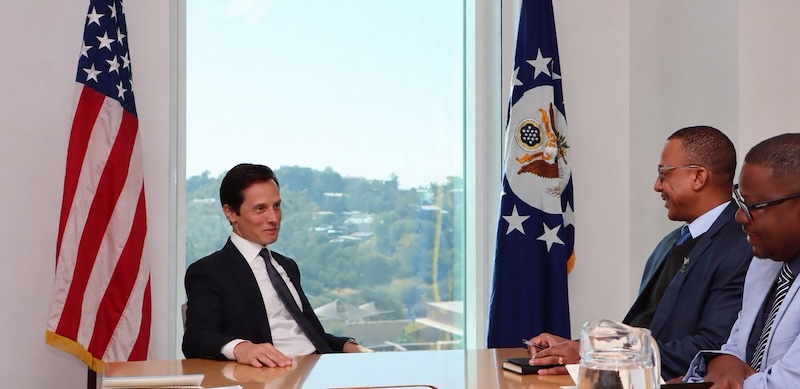
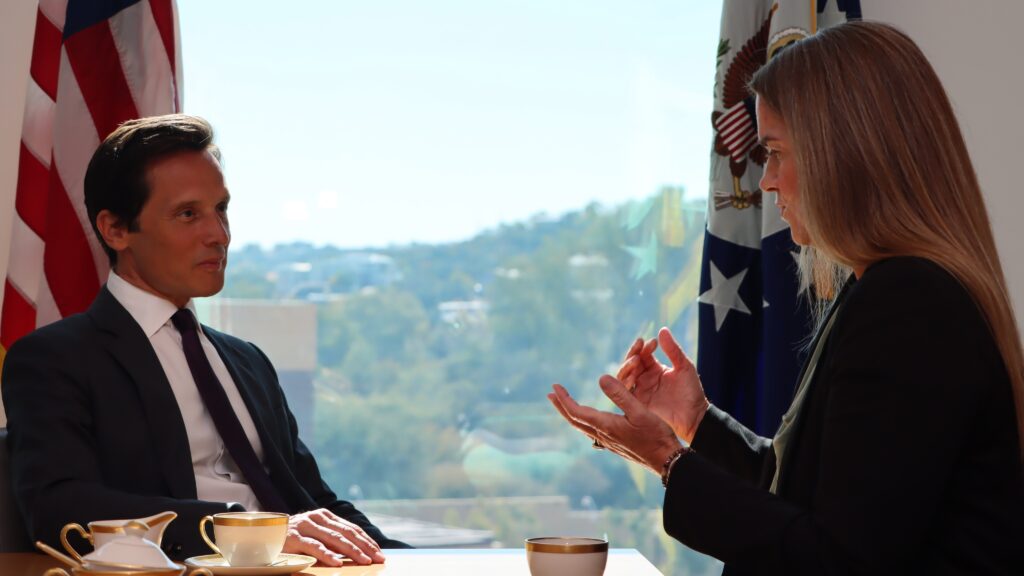
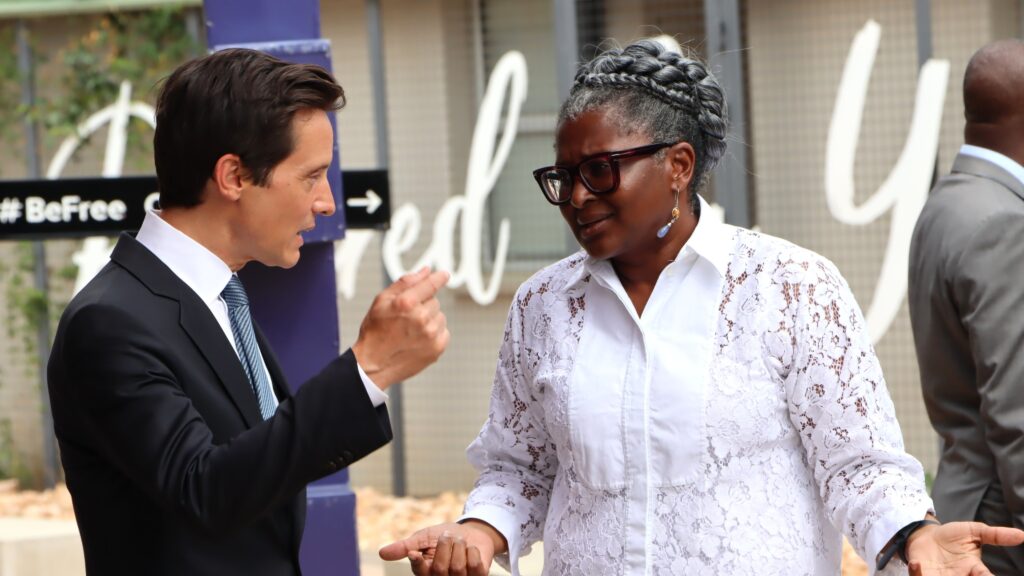
Namibia, for its part, is also trying to make itself easier for investors to understand.
Hellao said legislation under consideration in Parliament would clarify the business incentives, rights, obligations and approval processes that govern investment. The broader goal is to offer companies more certainty before they commit money, equipment and people. The legislation is expected to be approved by Parliament at the end of this year, he told me.
“There will be no waste of resources because Namibia is, first of all, very peaceful, the rule of law is there, and we have systems that are working,” Hellao said. “Americans should just come to Namibia to invest.”
A Different Type of Investment: Value-Addition
In fact, Americans have been coming to Namibia for decades. Decades before Angelina Jolie and Brad Pitt decided to give birth to their first child in the country, the first person to get an offshore diamond mining license in Namibia was a Texan, Giordano told me proudly as a matter of fact as we moved to the topic of creating jobs and value-addition.
When I asked both Ambassadors about their strategies for value addition, Hellao said that, for Namibia, the real issue is not simply whether foreign capital arrives. It is what that capital leaves behind.
African countries have lived through many versions of the extractive bargain. Foreign companies arrive, resources leave and the most valuable parts of the supply chain happen elsewhere. The host country receives revenue and, sometimes, jobs, but the technology, processing capacity and long-term industrial benefit, including long term employments tend to remain outside of its borders.
Hellao is clear that Namibia wants a different arrangement.
“First of all is to create skill development,” he said. “Secondly is job creation. Third is also to add value to the product, and that they are no longer being just shipped in raw form, but at least add value.”
Underscoring in plain language that his country does not want to be reduced to an export terminal.
That means in diamonds, value addition means local cutting and polishing. In oil and gas, it means service companies, technical expertise, and infrastructure. In lithium and other critical minerals, it means processing plants and manufacturing steps that keep more of the economic benefit within Namibia.
The idea may sound obvious, but it is one of the most consequential questions in Africa’s economic future: Who gets to do the work after the resource is extracted?
“Their [Americans’] intention actually is also to create what we call a processing plant, not only to mine, but also to set up a processing plant,” Hellao said of prospective American investors.
For a country with a young population and high youth unemployment, the answer cannot be “someone else.” He underscored: The promise of new investment will be measured not only in barrels, tonnes or export revenue, but in the number of Namibians trained, hired and given a real stake in the industries growing around them.
Giordano agrees and makes a case about American companies.
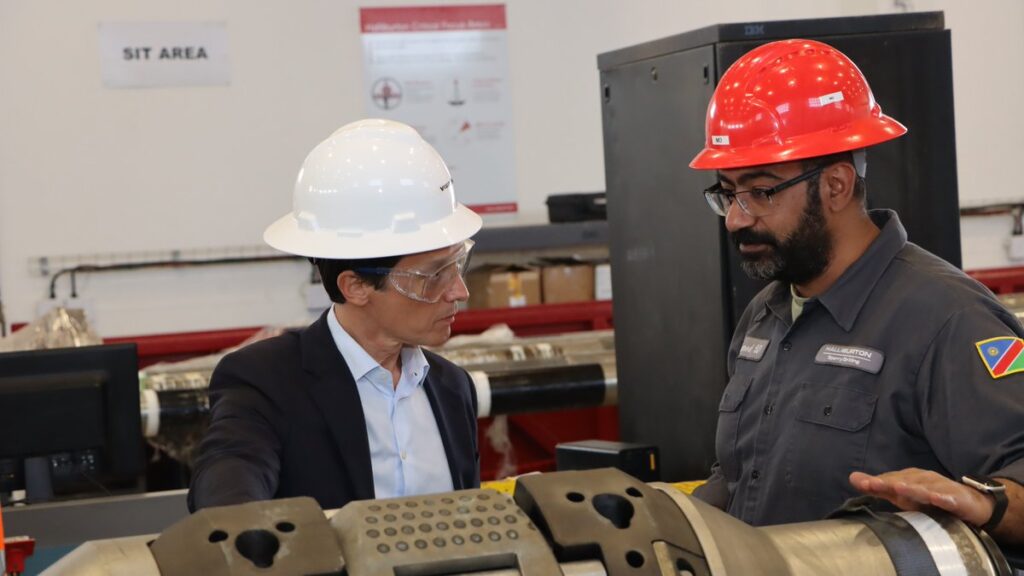
“When I say creating jobs for Namibians, I’m focusing on the benefaction aspects of things and the President of Namibia’s interest in growing her economy, and providing jobs, particularly for the younger set,” he explained. “Unemployment in the younger generation is in the high 40 percent and in creating these various opportunities for U.S. companies to come in, part of the American way of doing business is to hire locally, and so you have got big companies like Halliburton, Baker Hughes, and others servicing the super major Chevron and Shell, all hiring locally. So our commercial diplomacy in increasing our business footprint and increasing the footprint of companies like Halliburton is about increasing the opportunities for young Namibians.”
It is about the future. With the world’s largest young population, it is no secret to everyone that the future lies within Africa.
Asked what he would like his legacy to be as U.S. Ambassador to Namibia, he leaned back in his chair, thought for a few minutes before responding: “To leave the place [Namibia] better than I found it.”
If the past nine months are indicative of what to come during his term in Namibia, I have no doubt that mission would be accomplished.
Lasting Impact
As I wrote at the beginning of this story, some roads take you to a place. Other changes the way you see a place, the world and your place within it.
Revisiting my interview recordings and notes, I kept returning to one image: a long, open road leading to the future and possibility. This became the anchor for the article.
I find it especially fitting to tell Namibia’s commercial future through roads—and, in a way, through the distant echo of Route 66. The similarities might not be obvious but the parallel is there: both are roads that lead to new opportunities. Namibia’s roads do not rush you. They make you pay attention. They unfold gradually onto wide horizons of possibilities. And in this case, perhaps the future of global energy security and more.
Before Ambassador Giordano arrived in Namibia, he told me he went looking for information about the country as he prepared for his Senate confirmation hearing. Unsurprisingly, he found little. One book he found became essential reading; he tore out the pages on Namibia and studied them with the focus of a student preparing for an important exam.
Nine months later, he speaks of Namibia with the fluency of someone who has made it his mission to understand not only the country’s challenges, but also its promises. He knows the roads, the ports, the resources, and the people. More importantly, he sees how they can connect.
“We are building a partnership to last, with a relationship focused on commercial diplomacy—deals that work for both countries,” Giordano said. “It’s got to be mutually beneficial, or it doesn’t work.”
That is the right frame for this moment as the U.S. reimagines its relationship with Namibia and Africa as a whole.
Namibia or Africa does not want to be seen simply as a beautiful place at the edge of the map, a frontier to be admired, or as a source of resources to be extracted and sent elsewhere. It wants to be a place where value is created, skills are built, young people find meaningful employment and trade leaves something enduring behind.
Namibia—with its deep-water port, strategic resources and vast horizons—is making the case that it may be one of the places from which Africa’s next commercial map is drawn.