
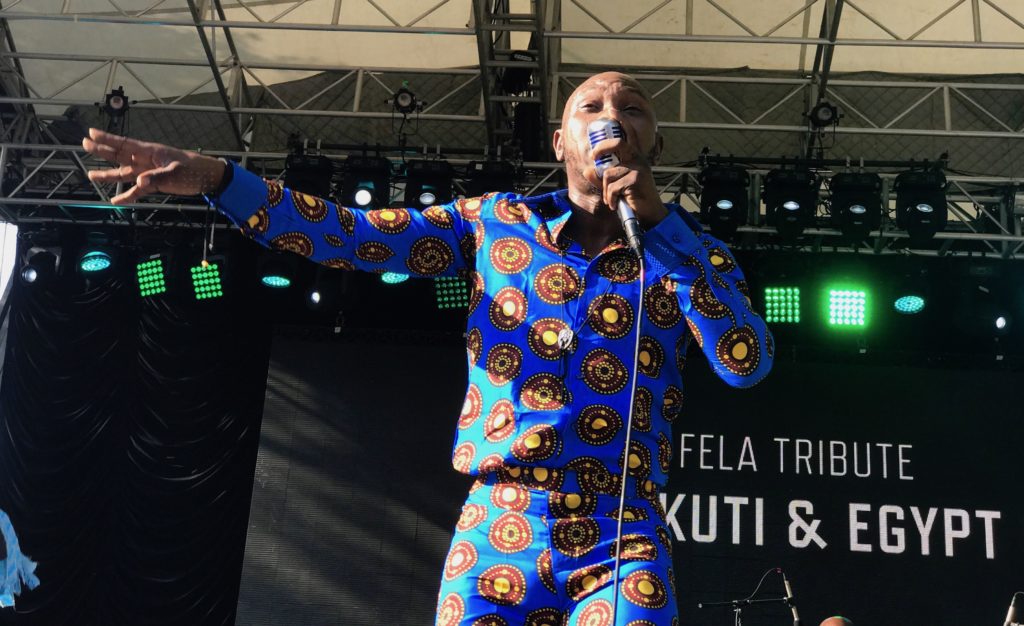
Seun Kuti, the youngest son of legendary Afrobeat music pioneer Fela Anikulapo Kuti, performs on stage in July 2017 at the Rumsey Playfield in New York Central Park. Photo by Kemi Osukoya
Kemi Osukoya
THE AFRICA BAZAAR magazine
July 2018″
Fela’s ideology drew people to his music and the band. The Shrine was very inclusive for both the marginalized and elite members of Nigerian society.
EXCLUSIVE – It’s not every day that I get a chance to live out a real-life, version of William Miller Almost Famous—but much older and with Afrobeat instead of rock ‘n’ roll. I had that improbable privilege last summer when I found myself with exclusive backstage access to a Fela Tribute Concert in New York and an unplanned, intimate interview with Seun Kuti, the youngest son of the legendary Nigerian musician and cultural revolutionary, Fela Anikulapo Kuti
None of it was planned. It all began at a neighborhood jazz show, where a new acquaintance mentioned that Seun would be performing the next day in New York’s Central Park. I had no idea what to expect, but was curious and very excited to attend the concert. The following afternoon, I was inside a backstage trailer at the Ramsey Playfield, notebook in hand, surrounded by musicians, smoke, instruments and history.
Meeting Seun in person felt like meeting Fela. The resemblance is more than physical—though the posture, the gait, and defiant gaze are unmistakable. It is in the way Seun speaks about politics without apology, without worrying about the obvious consequences and in the way music, for him remains inseparable from resistance.
I grew up with Fela’s music playing in the background in my family’s household. On weekend afternoons in the late 70s and 80s, my uncles would fill my grandparents’ living room with Fela’s trademark symphony of sounds of horns, African drums, trumpet, sax, and his unmistakable pidgin-English music. The rhythms spilled from the phonograph into the air like incense—transforming ordinary rooms into sites of dance, memory, and meaning.
Fela and King Sunny Ade were two of the most-played African musicians in our household. Both embodied the genius of African rhythm — an amalgamation of African traditional instruments and modern arrangement with a distinctive tempo that has been adapted to the African dance steps. You hear their music and instantly want to get up and dance.
But the similarities end there.
Where King Sunny Ade’s Juju music and songs tend to be more of a feel-good music that appeals to the masses, Fela’s musical appeal is how he skillfully delivered bewitching upbeat grooves, married to politically supercharged messages cloaked in songs. A musical pleasure armed with politics.
Fela, — the man, his music, and his lifestyle — were both controversial, magnetic, and inspirational in its singular vision of using Afrobeat music to mobilize and promote a sense of Africanism on the African continent and beyond.
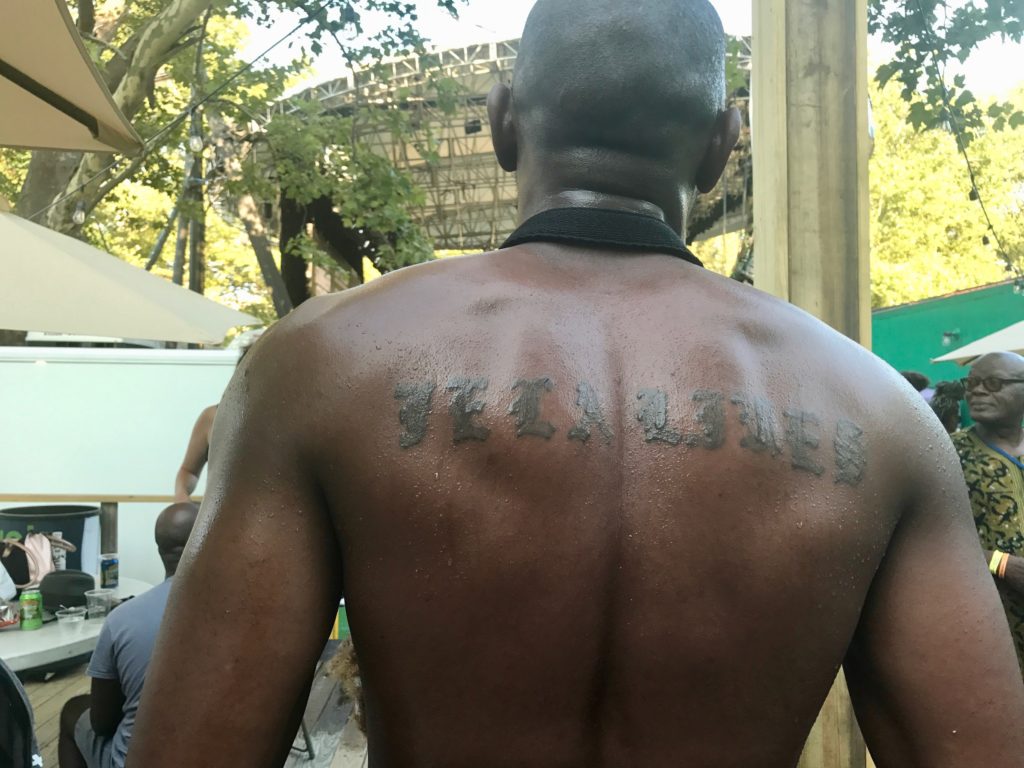
Tattooed on Seun Kuti’s back is “Fela Lives,” a tribute to his legendary Afrobeat pioneer late father, Fela Anikulapo Kuti. Photo by Kemi Osukoya.
It is apparent that Africa lost one of its most indisputable treasures and could have been left with a musical void after Fela died at the age of 59 in 1997 if his two sons, Femi and Seun Kuti, had not figuratively and literally stepped into their father’s musical shoes.
Musical dynasties are rare. The Fela Anikulapo Kuti family is one of the exceptions from Africa.
To watch Femi or Seun perform is to witness both inherited mastery and reinvention of what Fela created, and his ingenious generous musical gift, not just to Africa, but to the global music industry at large.
Those who knew Fela very well when he was alive knew he was renowned for his meticulous discipline to every detail of his Afrobeat music. From lyrical song writing and obsession with precision, to hours of band rehearsals, and fine-tuning until everything hits the right tone and becomes perfect—Seun, like his father, designs and redesigns his music until it reaches what he calls “eloquence.”
Fela lives on in Seun.
After Fela’s death, Seun became the heir to Fela’s afrobeat band, Egypt 80, having played with the band since he was 14 years old.
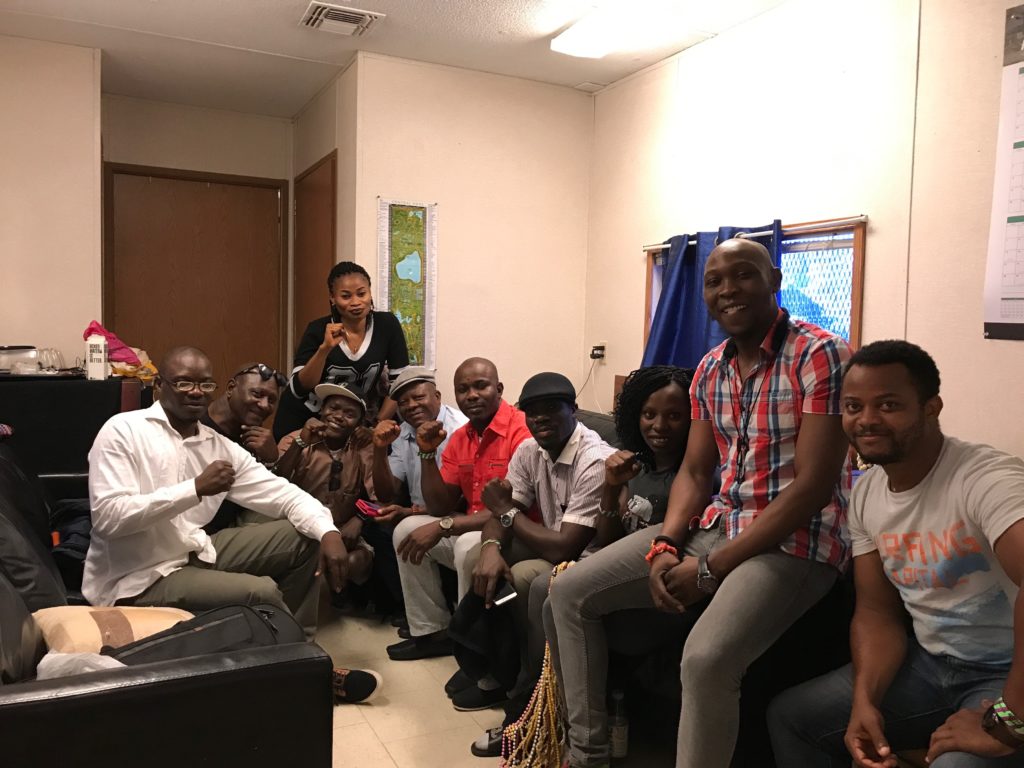
Backstage, members of Seun Kuti & Egypt 80 at the Fela Tribute concert in New York City. Photo by Kemi Osukoya.
His first decision as band leader was radical in its humility: he kept the band exactly as it was, adhering to the adage “If it ain’t broke, don’t fix it,” he told me. That choice preserved not only the family’s fifty-year-plus musical dynasty in business, but it has also helped him redefine and reclaim his father’s legacy for a new generation of music listeners.
As Seun explained to me during the exclusive interview with the Africa Bazaar magazine, Fela was larger than life and is still the ultimate inspiration for him and his brother Femi, their bands, and many other musicians.
“Growing up with my Dad, for me, he is the ultimate inspiration for my music,” Seun said. “Wanting to be a musician and living the life of a musician was from being around him and watching him do what he did.”
He began going on music tours with his father at a very young age and auditioned for his father backstage at the legendary Apollo Theater in Harlem in 1990 when he was seven years old,
“As a child, you don’t know the complexity of life. You just know what you see, but don’t understand what is behind it,” he told me, smiling as he fondly recalled his earliest memories of accompanying his father on music tours. “As a child, I just thought it was the easiest job ever to do. I always could sing, so I asked my Dad for an audition.”
How did he know what he wanted at that age and know how to prepare for an audition, I asked him.
“I didn’t even prepare,” he replied smiling. “He told me to sing. I sang one of his songs, ‘Sorrows, Tears and Blood.’ I can never forget that moment—the look on my Dad’s face as I sang.”
As he recalled this sentimental special moment, Seun unexpectedly began singing the song—softly, reverently~There’s be sorrows, tears and blood/ them regular trademarks/them regular trademark~ For a moment, time collapsed for the people in the interview room, myself, his girlfriend, and manager.m, in what I will underscore to be a rare sentimental moment.
(Just try to imagine for a moment that you’re interviewing Bruce Springsteen or Bono from the U2 band, and he starts singing and performing in front of you, I bet you will find it special too.)
Without missing a beat, he continued our conversation after his performance. “That was the precise song that I sang and [Fela] said, ‘Okay, not bad.’”
Just as that audition moment with his father is still sentimental for him, I will also always remember that intimate performance Seun gave to us in that room.
After that audition, Seun joined the Egypt 80 band and started practicing and playing with the band once they returned to Lagos. He quickly learned how to play the piano, saxophone, and the unwritten law and nuances of his father’s Afrobeat music business.
Over the years, he has matured, and evolved, not just in age, but also musically. While fiercely channeling Fela’s fiery energy, and also carving out his own image, he remains humble enough to acknowledge and respect his place in the grandeur of his father’s music legacy and lineage.
His albums— Many Things, produced by his father’s music producer, Martin Massionier, and the 2011 released of From Africa with Fury: Rise, carry forward the protest tradition. His latest, “Black Times,” which features Carlos Santana, was released earlier this year in March, is a call for solidarity across race and class.
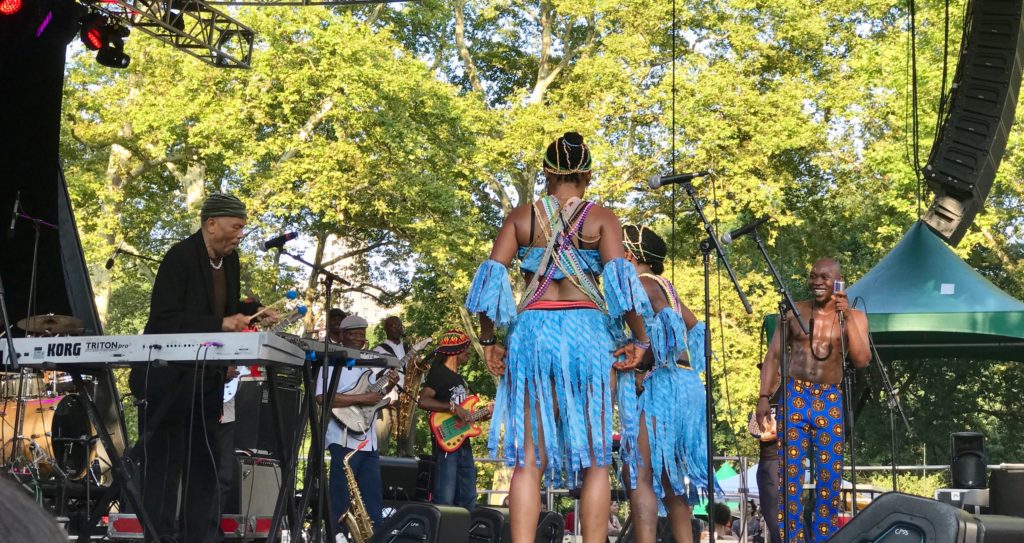
Seun Kuti & Egypt ’80 share the stage with Roy Ayers during a concert performance at the Fela Tribute concert in New York. Photo Kemi Osukoya.
At the time of our interview last year, Seun told me he was still putting the finishing touches to the Black Times and was heading to Los Angeles, following the NYC concert to meet up with guest artists that will perform on the album.
“The album is a call for unification of humanity to understand that call together and elevate all of humanity, not just a privileged few,” he says. “So for me,” he continues, “that’s the deep inspiration because all over the world, I see a lot of black and brown people being labeled and subjugated and oppressed under the elite narrative of what’s going on in the world. For me, that’s what the album is about and it’s what inspired me to start to write.”
Seun, who like his father believes in and embraces African culture and identity, is a social commentator, and critic of elite groups, particularly those from and living on the African continent.
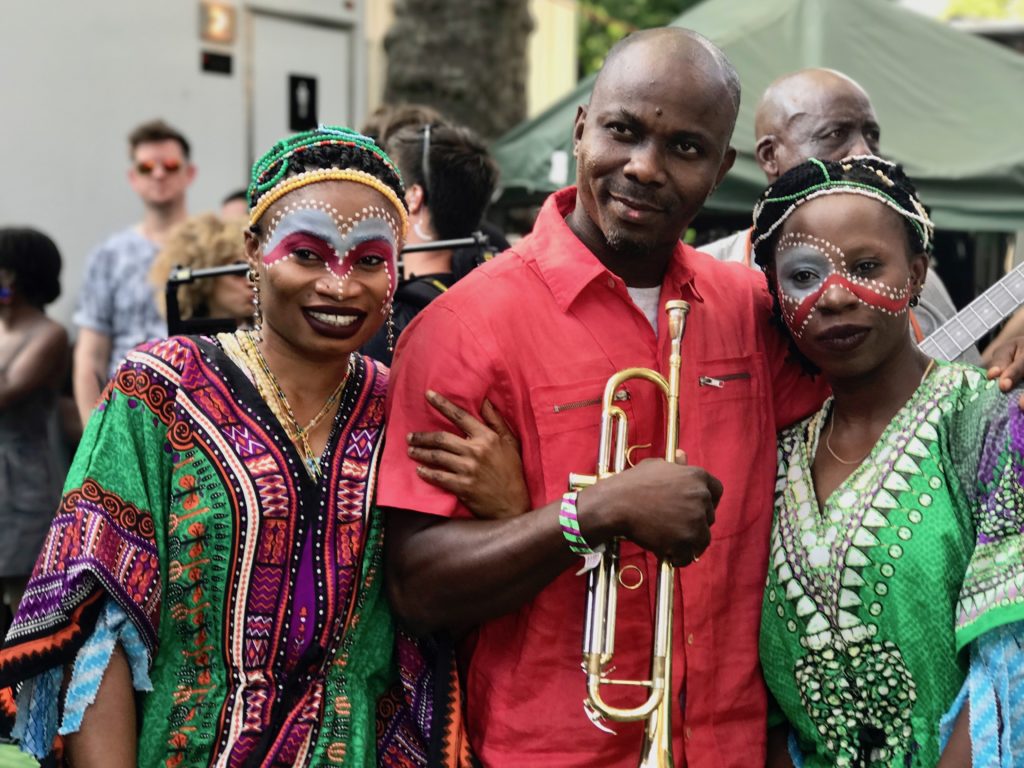
Backstage, the members of Seun Kuti & Egypt 80 band pose for a picture before their performance Photo by Kemi Osukoya.
“The real struggle is the class struggle,” he told me. “A lot of the people that are trapped in poverty all over the world are black and brown people and I believe our working-class comrades in Europe and America could be more considerate about the plights of their comrades in the black and brown world other than ignoring that.”
Indisputably, writing protest songs has been hard-wired into his DNA since he joined his father’s band. However, carrying on the Afrobeat music to a new generation while maintaining the musical high bar set by Fela might seem unattainable and can easily sink an unskilled, and untalented musician. Seun, in no doubt, has succeeded. Upon seeing his stage performance, anyone who ever doubted him to carry on his father’s legacy will immediately see that not only has he morphed into Fela, but one could say he has triumphed into an extraordinary performer in his own right.
That Sunday in Central Park, Seun and Egypt 80 returned to New York for the first time in nearly a decade and I was privileged to join them backstage before their performance at the Rumsey Playfield.
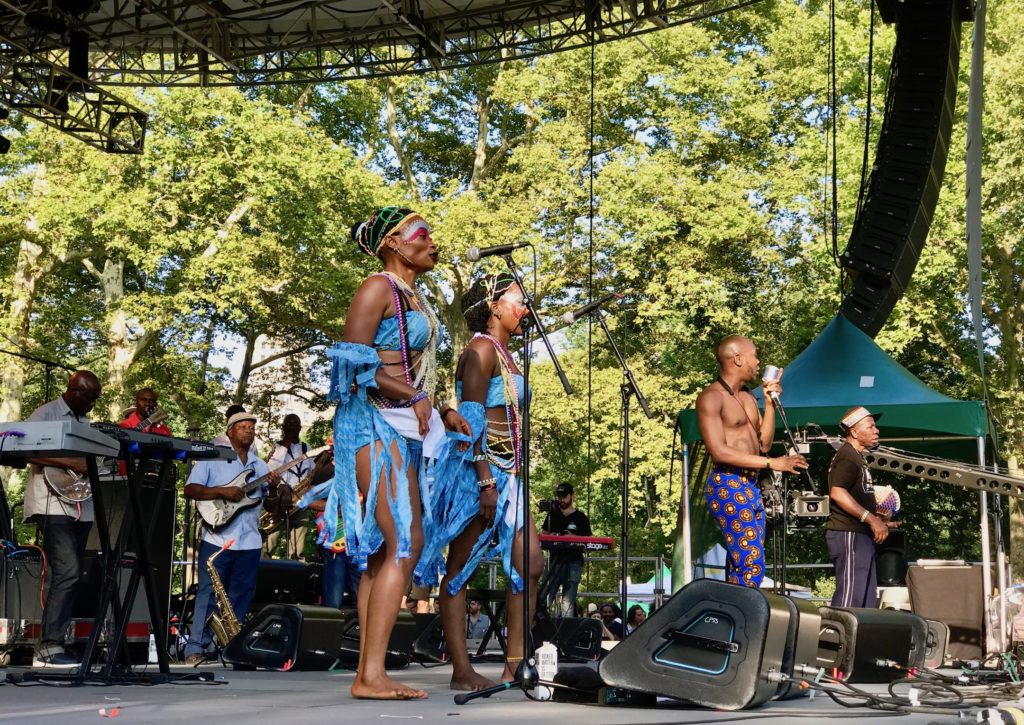
Seun Kuti and his dancers performed during the Fela Tribute concert at the Rumsey Playfield. Photo by Kemi Osukoya
The concert, a Fela Tribute featuring Seun Kuti & Egypt 80, Roy Ayers, the Underground System and Rich Medina, was organized by Ben Levy, a music producer and manager of legendary black music icon Ray Ayers.
Seun and his band did not disappoint the audience who had waited long enough to see the band perform again in NYC.
For me, it was enthralling watching them backstage and onstage.
Backstage in a trailer room, I sat on a chair, inconspicuously in a corner of the room, while observing and quickly taking notes of the band’s activities as they prepared, rehearsed songs, fine-tuned musical instruments, and got dressed for their stage performance that evening.
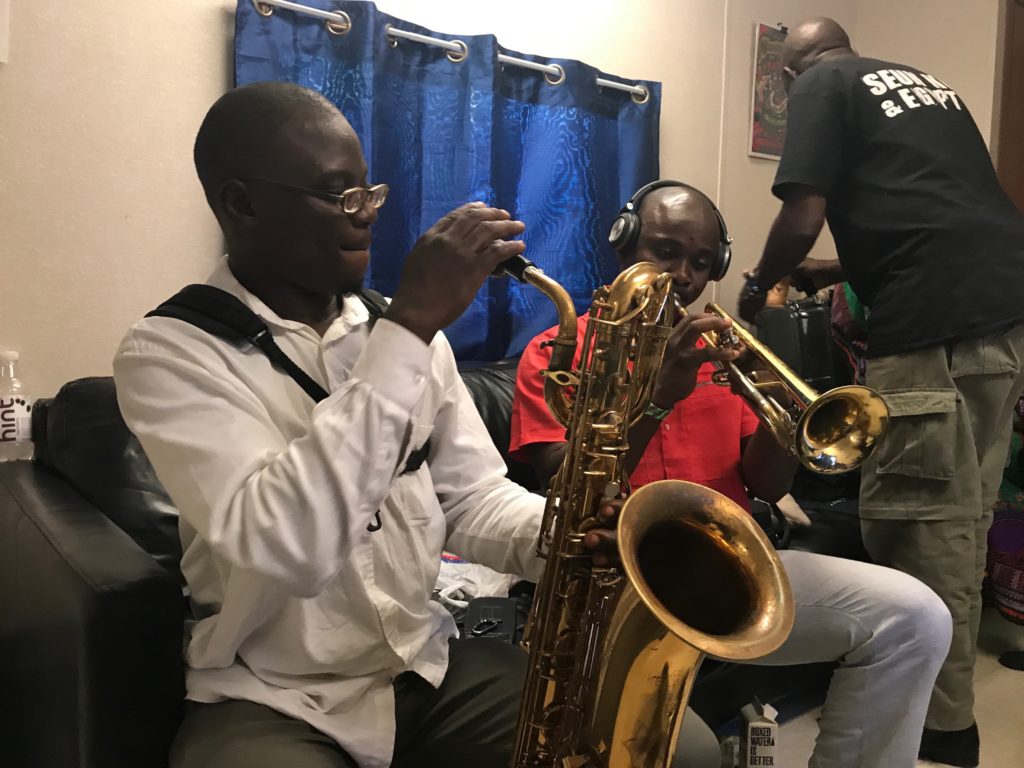
Backstage, members of Seun Kuti & Egypt 80 prepared and tested their instruments before their live performance at Rumsey Playfield in New York City. Photo by Kemi Osukoya.
Like most edgy bands, they have the rituals they partake in before going on stage. For Seun and some of the band members, smoking a little joint before their stage performance is all part of the creative process.
I have never smoked in my life. But that afternoon, I tried not to let the poignant smell of cannabis bother me too much. Moreover, the experience of being backstage at a music concert was in its way a lot more intoxicating and exhilarating for me than the smell of weed.
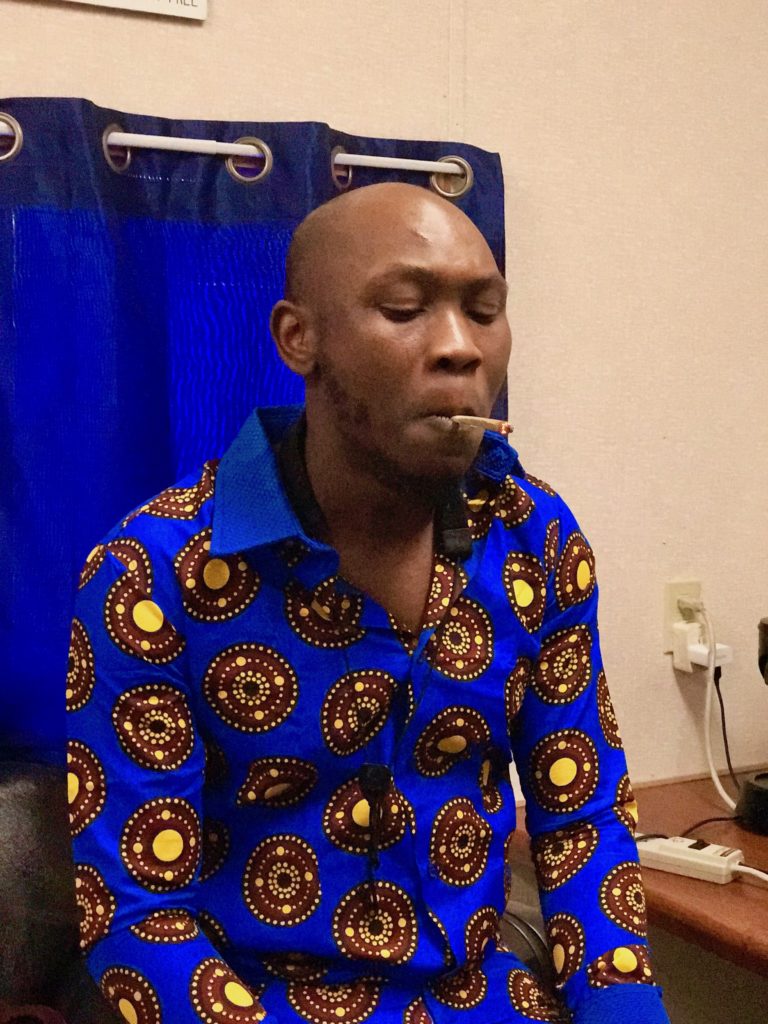
Backstage, Seun Kuti takes a moment to enjoy a special ritual just a moment before going on stage to perform for the audience at the Rumsey Playfield in New York Central Park. Photo Kemi Osukoya.
So much of the band’s powerful and effortless stage performance lies in its passion, uniformity, loyalty, and respect, among the band members. This was obvious to me from the ways they interacted with each other. However, it is hard to judge a band’s closeness and how they get along after observing them for a day. What I found unique about the Egypt 80 is an unpretentious camaraderie, and a joyful sense of family loyalty among the band as they laugh, tease, and tell jokes with each other and their band leader, whom they affectionately refer to as the “Chairman.”
Most of the members have been with the Egypt 80 since its formation when Fela established the original Egypt 70 band in the 70s. For them, the Afrobeat music and the Fela legacy is a singular vision and lifestyle that’s based on loyalty above all.
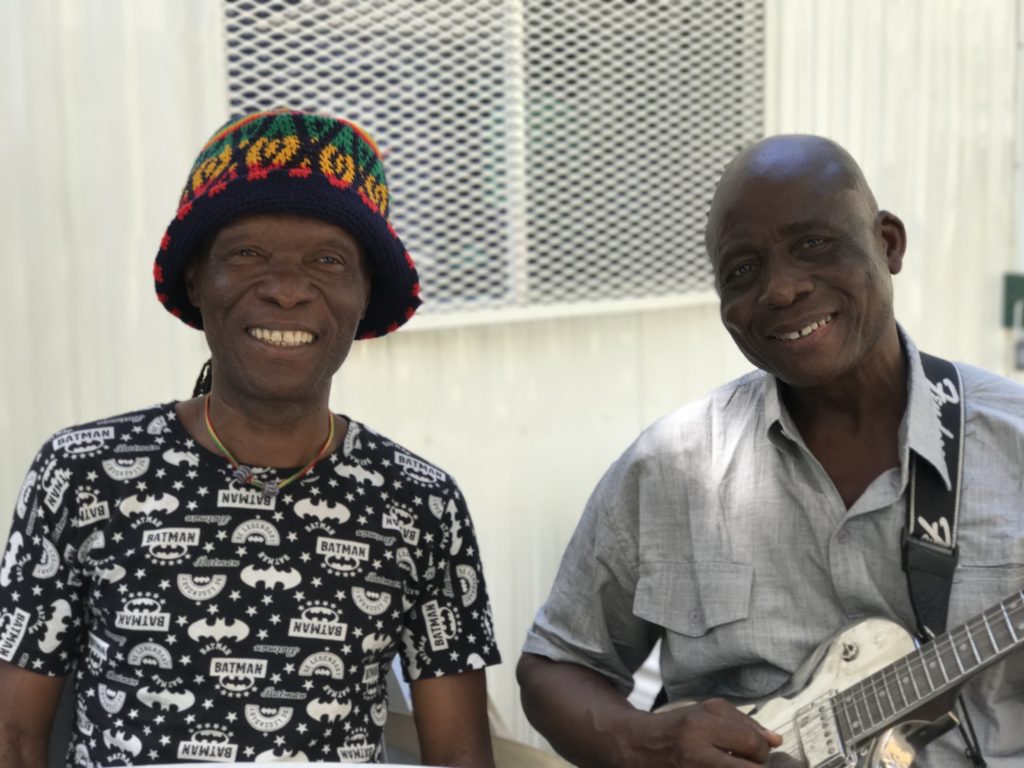
Backstage at New York Central Park’s Rumsey Playfield, two senior members of Egypt 80 take a moment to relax. Photo by Kemi Osukoya
“The reason why I came to Fela is because of his ideology,” a senior band member who joined Fela’s band in the early 80s told me. “When we talk about their music, Seun’s music and Fela’s music are different in their deliveries, but they both carry the same political message. Their message concept remains the same.”
Before becoming a member of the Egypt 80, he lived on the streets of Lagos for many years, ostracized from his family in Nigeria, he told me. Fela’s Kalakuta compound in Ikeja, Lagos became his home.
“Fela’s ideology drew people to the band. It was inclusive for both the marginalized and the elite members of the Nigerian society,” he said. “Everybody was welcome at the Shrine. So to carry on [Fela’s] legacy through Seun and mentor the new generation of musicians that are coming into the band is based on passion rooted in our loyalty to the man.”
We left the trailer and made our way to the concert backstage. I stood to the side of the stage and watched Seun walk towards the Rumsey Playfield stage, along the way greeting, shaking hands, and hugging friends, and fans who had come, as far as London, to say hello to him backstage and see him perform on stage.
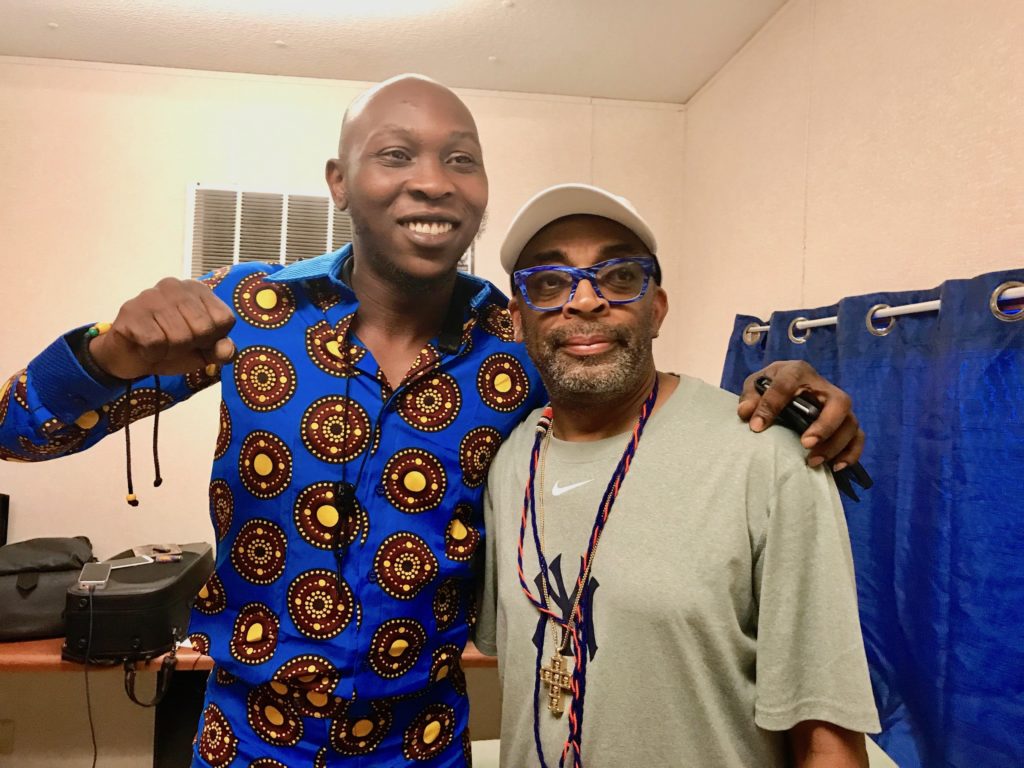
Celebrated African-American filmmaker Spike Lee hangs out with Seun Kuti backstage at the Fela Tribute Concert in New York City. Photo by Kemi Osukoya.
One of those fans who came backstage to see Seun is the legendary African-American filmmaker, Spike Lee. I got a chance to listen in on their conversation as Lee disclosed newfound details about his ancestral roots to Seun. (Check out the video on our Facebook page and YouTube).
The moment Seun stepped on stage, carrying his saxophone, the audience went wild with excitement.
Wearing Ankara fabric from head to toe, saxophone in hand, he lifted the mouthpiece and blew the first notes into the open air. Afrobeat surges outward—horns drums, hip, history. The crowds, having waited long to see him perform, were already on their feet, applauding and shouting excitedly, dancing as the band began to play the first song of the concert.
Watching him sing, dance, and command the stage, I wondered briefly how long he could keep on carrying the weight of his legendary father’s legacy. However, that perturbation quickly dissipates into a sense of awe and admiration. I understand why his fans are so hypotomized by his performance. It’s like being in a musical dance spell that leaves no doubt in my mind and anyone else’s mind that Fela is very much alive in Seun.
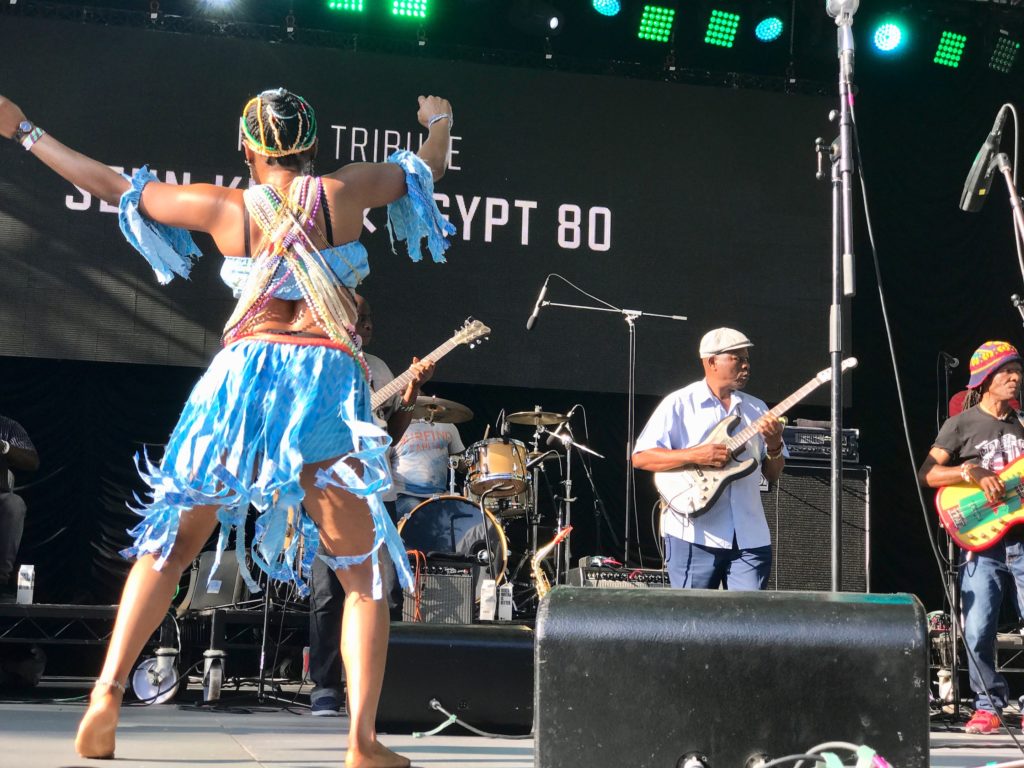
The Egypt 80 dancers perform at the Rumsey Playfield. Photo by Kemi Osukoya.
Fela was no longer a shadow. He was in motion, breath and sound- alive in his son.
One can only imagine Fela smiling somewhere above with pride, remembering the seven-year-old boy who once sang “Sorrow, Tears and Blood@ at the Apollo.
Africa and the world are fortunate to witness this inheritance not as nostalgia, but as a living music and to have such a great treasure.
© 2018 THEAFRICABAZAAR magazine, a publication of Imek Media, LLC. All rights reserved.