
Kemi Osukoya | World Briefs & Policy
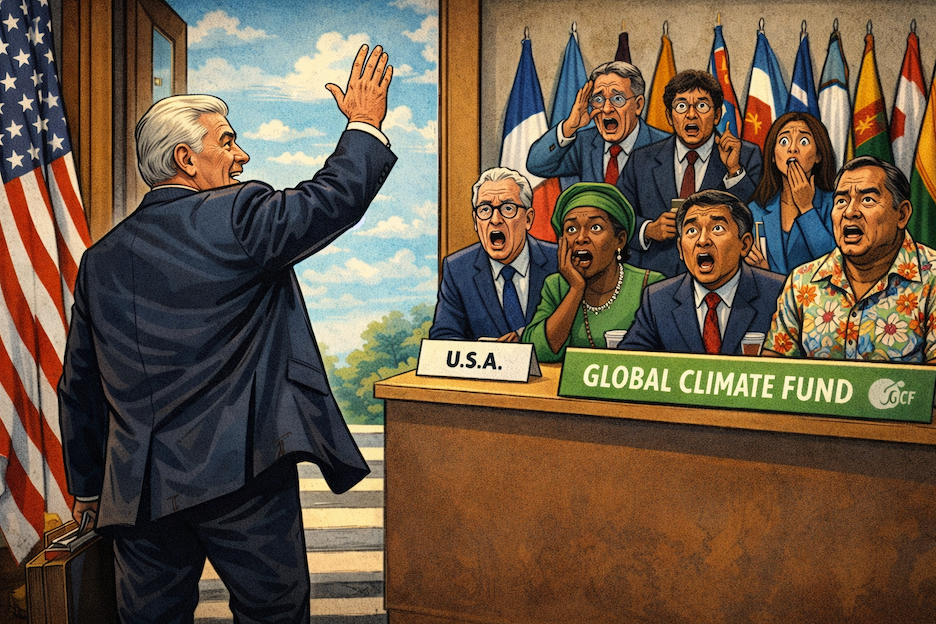
The United States has formally withdrawn from the Green Climate Fund, dealing a sharp blow to one of the largest multilateral financing vehicles for climate projects in developing economies and underscoring Washington’s accelerating retreat from global climate diplomacy under President Trump.
In a statement Thursday, the U.S. Treasury said it had notified the Fund that the United States was exiting immediately and relinquishing its seat on the GCF board. The move aligns with the administration’s broader withdrawal from the UN Framework Convention on Climate Change and follows a sweeping White House Presidential Memorandum pulling the U.S. out of dozens of international organizations and agreements deemed “contrary to the interests of the United States.”
“Our nation will no longer fund radical organizations like the Green Climate Fund,” Treasury Secretary Scott Bessent said, arguing that the Fund’s priorities conflict with the administration’s view that affordable, reliable energy—not climate finance mandates—is the foundation of economic growth and poverty reduction.
Going to Davos this month for the World Economic Forum? Fly comfortably on Qatar Airways to Switzerland to attend or book now for your next conference/business meeting trip to/from the U.S., U.K., or France and stay at IHG hotel nearby. Check Out these flights and hotel deals:
Disclosure: THEAFRICABAZAAR may earn a commission when you buy a product from our affiliate partners via the links at no additional cost to readers
QR Homepage – Switzerland (CH) / (EN)IHG Hotels:
We promise you the lowest available price online, or we’ll match it and give you five times the IHG® Rewards Club points.Established to channel capital toward climate mitigation and adaptation in developing countries, small island states and least-developed economies, the Green Climate Fund has played an outsized role in financing renewable energy, climate-resilient infrastructure and disaster preparedness across Africa, Asia and the Pacific. Its mandate calls for a roughly equal split between mitigation and adaptation spending—an increasingly critical balance as climate shocks intensify in vulnerable economies.
For developing countries, the U.S. exit is more than symbolic. It removes one of the Fund’s most influential shareholders and weakens its ability to mobilize concessional finance at scale. African governments and small island states—already grappling with rising debt, volatile capital flows and escalating climate risks—now face a wider financing gap just as adaptation needs surge. Projects tied to flood control, drought resilience and off-grid energy access may struggle to secure funding or face higher costs as private capital demands greater returns.
The decision also sharpens the geopolitical divide in climate finance. While Europe and parts of Asia continue to expand green funding commitments, Washington is signaling a pivot toward energy pragmatism and domestic priorities, leaving multilateral climate institutions to rely more heavily on non-U.S. donors. For emerging markets, that shift could mean slower project pipelines, greater dependence on bilateral deals, or a turn toward alternative financiers—including China and the Gulf states—whose capital often comes with different strategic strings attached.
The Treasury’s announcement follows an Executive Order issued by President Trump in February directing a comprehensive review of U.S. participation in international bodies. That review has now translated into exits from a broad range of climate, development and cooperation frameworks, reinforcing a U.S. posture that treats multilateral climate finance as a liability rather than a lever of global influence.
As climate risks rise and concessional funding tightens, governments across Africa and the developing world would have to rethink how they fund resilience—leaning more heavily on domestic resources, private capital and regional partnerships to fill a growing gap left by Washington’s departure. The message is stark: climate finance will increasingly be shaped by geopolitical alignment and market discipline, not global consensus.