
And the Quiet Power of “Special Relationship”
By Kemi Osukoya | WORLD BRIEFS
Shakespeare, ever attuned to the theater of power and performance wrote in As You Like It, “All the world’s a stage. And all the men and women are merely players,” imagining a court where performance and power blurred into one.
In Washington this week, the stage is set for an impeccable performance—a White House State Visit is no less theatrical, only the stakes are geopolitical, the audience global, and the choreography calibrated into the smallest gesture. What appears as pageantry and performance also conceals deeper truths. A monarch is there to send a message and to help steady the moment.
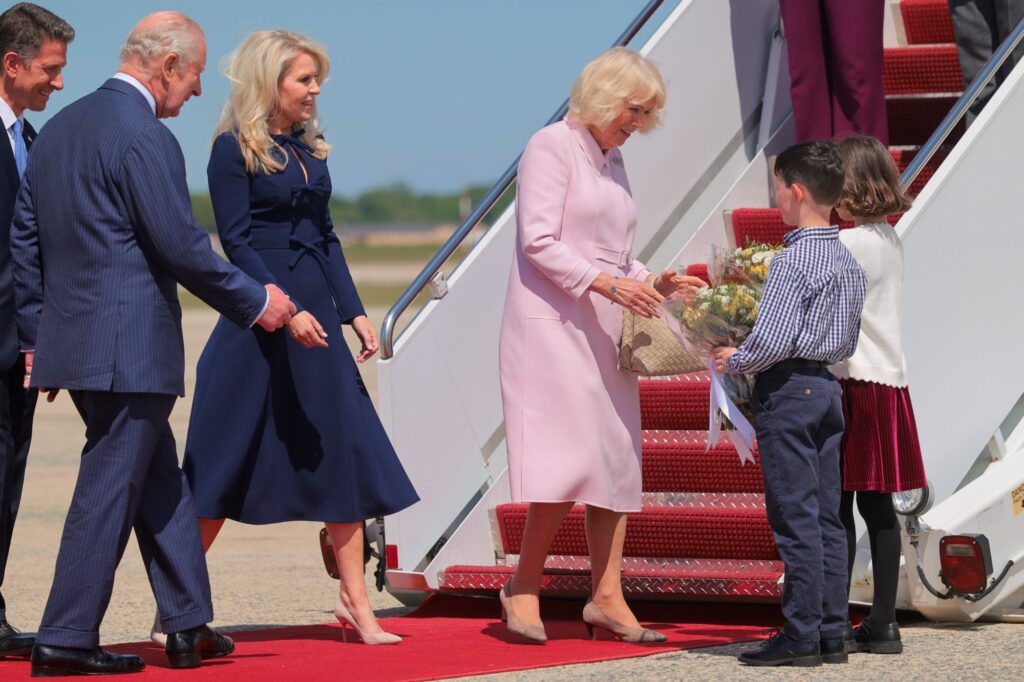
King Charles III and Queen Camilla‘s arrival in Washington on Monday afternoon for a four-day U.S. visit brings the familiar, polished rhythm of a modern state visit layered over urgency. Greeted first at Joint Base Andrews by the British Ambassador to the U.S. Christian Turner and U.S. Chief of Protocol Monica Crowley and other British Embassy staff, then followed by a welcome ceremony at the White House by President Donald Trump and First Lady Melania Trump, the choreography is predictable: the ceremonial lines, the smiles, the photo ceremony, and the quiet glide into the Green Room for a private tea reception. But beneath the pageantry, this visit hums with subtext—a recalibration of tone at a moment when the world feels increasingly off-balance.
There is something almost poetic, if not ironic, about the timing. The visit marks the 250th anniversary of American independence from Britain—a historical rupture now reframed as one of the most durable alliances in modern history. It is the seventh such State visit by a British monarch to the United States, arriving on the heels of Trump’s own unprecedented second state visit to the United Kingdom last September, reinforcing what both sides describe as “special relationship.”
But even special relationships require maintenance.
In recent months, pressure points have surfaced—Ukraine, the ongoing arc of conflicts in the Middle East, trade tensions and tariffs that quietly strain even the closest partnerships. Add to that a personal rift between Trump and Prime Minister Keir Starmer—particularly over Britain’s refusal to join what Starmer has described as America’s “latest war of choice”—and the visit begins to look less like ceremony and more like strategy.
If you have ever wondered about its relevance in a progressive world, well, this is where monarchy earns its keep. While Charles is not a policymaker, does not negotiate treaties or dictate trade terms, his presence—neutral, carefully measured—works as a kind of diplomatic reset. It lowers the temperature and reminds both sides that their alliance runs deeper than trade tensions and politics, and is more resilient than any single administration or disagreement.
It is soft power in its purest form.
And so the optics matter. The South Portico greeting. The quiet intimate tea reception in the Green Room. The beehive tour in the White House garden—slightly whimsical, yes but also a quiet nod to Charles’s long-standing advocacy for environmental stewardship, and sustainability, delivered without turning it into a political statement is a testament to First Lady Melania Trump and her team’s mastery of balancing diplomacy with elegance.
On Tuesday, the second day of the State Visit, the schedule moves with purpose: The President and First Lady Melania will welcome the King and Queen back to the White House for an official State Visit ceremony. Afterward, Charles is expected to address a joint session of Congress—a rare and symbolic gesture—before returning to the White House in the evening for a state dinner. On Wednesday, the location shifts to New York: a wreath will be laid at the September 11 memorial, followed by a visit to Harlem by King Charles, highlighting programs for children facing food insecurity, and a visit by Queen Camilla to the New York Public Library’s centennial celebration. The final stop on Thursday is in Virginia, with a solemn tribute at Arlington National Cemetery.
State visits optics aside, to view this visit solely through the lens of a U.K.-U.S. transatlantic relations is to miss its broader resonance—particularly for Africa.
Threaded through the visit is the quiet structure of the Commonwealth of Nations—a network of 56 nations, including Canada and many of them African, linked by history but operating without binding political authority that works as a platform for cooperation on democracy, trade, education, and cultural exchange.
For African nations—from Nigeria to Rwanda, from South Africa to Ghana—the Commonwealth represents opportunity and offers access, visibility, and a framework for collaboration that stretches across continents. But it also carries the echoes of empire, raising persistent questions about equity, agency, and the true balance of power within the association.
Against that backdrop, a state visit like this is more than bilateral theater. It is a signal—to Commonwealth countries, to emerging markets, to the Global South—that the old alliances are still being tended, still being prioritized, and still shaping the contours of global influence.
This matters, for Africa in particular. The deepening ties between the U.S. and the UK—reinforced through moments like this—have ripple effects on trade, development financing, security cooperation, and diplomatic alignment.
As global power shifts and multipolarity becomes the defining feature of the international system, the positioning of these alliances will influence where investment flows, how policies are coordinated, and which regions are elevated—or sidelined—in the global agenda.
In other words, the choreography in Washington is not just about Washington. It is about who gets invited into the next chapter of global cooperation—and on what terms.
Therefore, the carefully curated appearances—the beehive tour is not just a charming aside. The garden party is not just nostalgia. The speeches, the wreaths,—they are all part of a larger narrative that seeks to project stability in an unstable world.
And of course, some shadows linger, too during this State visit. The scandal surrounding King Charles’s brother, Prince Andrew, and his association with Jeffrey Epstein remains an unspoken backdrop—proof that even the most choreographed visits cannot entirely escape the weight of unresolved controversies.