
INSIDE AFRICA | BUSINESS
Wole Soyinka’s play The Lion and the Jewel was set in a Nigerian village, but its questions about progress, power and who gets to decide what modernity should look like feel surprisingly relevant to Guinea today.
In Soyinka’s play, Sidi—the jewel—is caught between competing visions of her future. The struggle is not simply over possession. It is also about who gets to define the terms of change.
Guinea’s mineral wealth is now caught in a similar contest as major powers in the global economy—the U.S., China, the European Union and others, seek a piece of its vast bauxite reserves and the iron ore deposits at Simandou.
Guinea wants the investment. It needs the capital, technology and infrastructure that foreign companies can bring. But it also wants to decide what modernization looks like on its own terms.
That means turning bauxite into alumina, building the energy and transportation infrastructure needed to support industry, creating jobs for Guineans and giving local companies a larger role in the economy.
In other words, the jewel is not simply the mineral in the ground. It is what the country can build around its resources and how much of the value it can keep at home.
That is the question at the heart of Guinea’s economic pivot: not simply who gets access to its mineral wealth, but what Guinea can build from it.
This premise is also at the center of the country’s push to deepen business ties with the U.S. while moving beyond its traditional role as an exporter of raw materials.
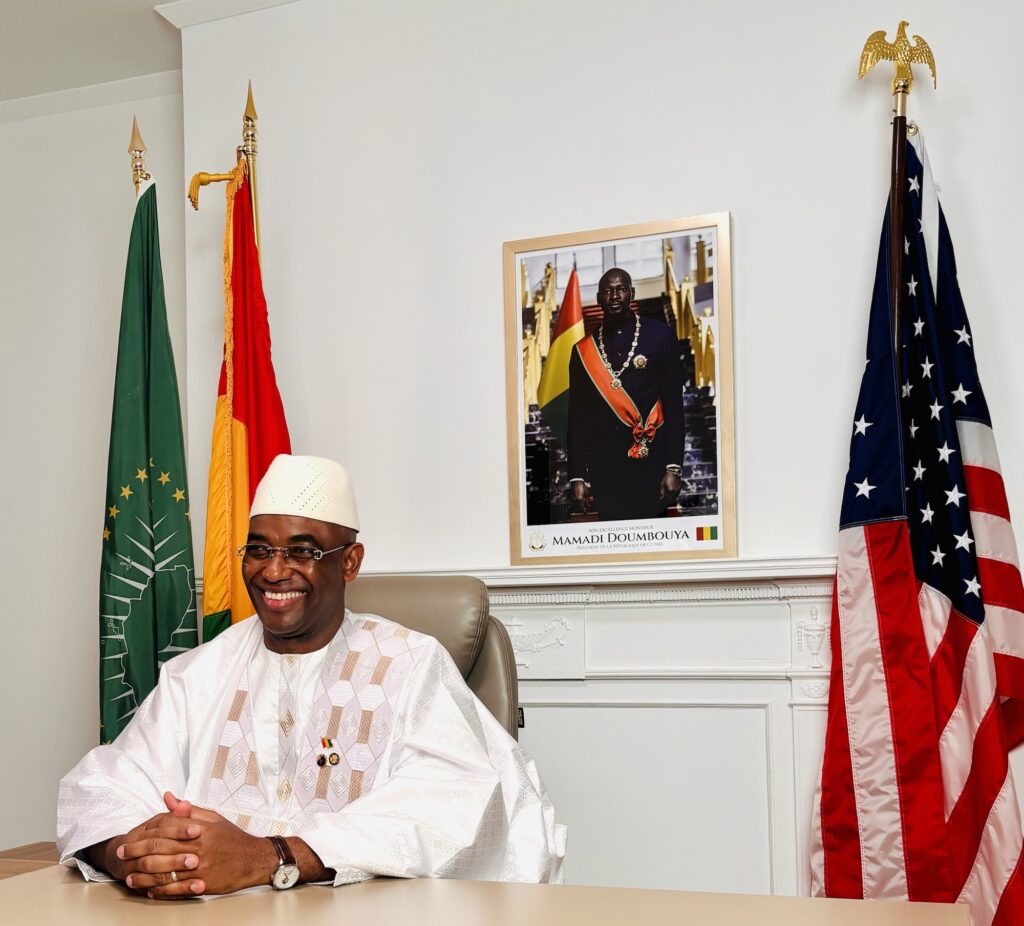
“We are ready to have U.S. investment because we are in the process of transforming our economy,” Guinea’s Ambassador to the United States H.E. Ibrahima N. Diallo told the Africa Bazaar in an exclusive interview following the presentation of his credentials to President Donald Trump at the White House.
That transformation includes building new refineries, infrastructure and power capacity, creating jobs, developing local businesses and bringing more processing into the country.
The mineral wealth serves as a starting point for how the country’s plans to transform its economy.
The pitch comes as Washington and American companies look for ways to diversify mineral supply chains that remain heavily concentrated in China.
Guinea offers a potential solution to that diversification challenge.
The country was the world’s major bauxite producers, accounting for about 33 percent of global production, according to the U.S. Geological Survey‘s report. Its bauxite reserves are estimated at about 7.4 billion metric tons.
Bauxite, however, is only the beginning of Guinea’s story.
The country also holds substantial iron ore, gold and other mineral resources.
Bauxite ore is the principal commercial source of alumina, which is then processed into aluminum—a metal used in aircraft, automobiles, electrical systems, construction, defense equipment and other industries.
This is where Guinea’s ambitious industrialization agenda aligns with the Trump Administration’s critical-minerals diversification strategy. Aluminum is included on the U.S. government’s 2025 list of critical minerals.
That elevates Guinea beyond simply being another African mining market for Washington to a potential source of diversification in a global minerals system in which China occupies a dominant position in processing and refining.
But Guinea’s ambitions are broader than supplying another customer, Diallo said.
For decades, Guinea’s mineral economy has largely followed a familiar African pattern: extract the resource, ship it abroad and capture a relatively small share of the value created further along the supply chain.
The government is now trying to change that equation through its Simandou 2040 program, where it has laid out an ambitious development plan spanning agriculture, energy, industry, infrastructure, transport, finance, health and technology.
Diallo says the program includes 122 major projects and 36 structural reforms and could require more than $200 billion in investment through 2040.
The mineral sector sits at the center of that strategy.
The Ambassador described Guinea as a country with enormous potential not only in mining but also in agriculture and energy. He said the government wants foreign investors to bring technology and expertise alongside capital.
“We want to create jobs locally,” he said. “We want to give businesses to Guineans, and also we want to transfer competencies and technologies to Guinea.”
This is where The Lion and the Jewel analogy becomes useful in understanding Guinea.
Baroka, the 62-year old village chief from Soyinka’s novel, does not outright reject modernization. Instead, he objects a version of progress imposed by outsiders.
Guinea’s challenge is similar in economic terms: how ca it attract the capital, technology and infrastructure it needs without remaining locked into a model in which the most valuable stages of production happen elsewhere.
The government is trying to answer that question through local processing.
The emphasis on domestic participation and local processing of resources is becoming an important part of Guinea’s investment strategy. The country’s local-content framework requires companies to prioritize Guinean employment and training, while the government has increasingly tied major mining developments to broader industrial and economic objectives.
The U.S. State Department has also previously identified mining, energy, agriculture, information technology and infrastructure as areas with potential for U.S. investment in Guinea.
This gives U.S. companies opportunities to tap into Guinea’s investment portfolio beyond mining.
While Guinea is already a major global mineral producer, particularly in bauxite, it is not a current major direct supplier of most minerals to the U.S.. Its strategic significance to Washington lies more in what it could become than in an existing American dependence on Guinean minerals.
Iron ore is not on the U.S. government’s critical-minerals list, so Simandou is not a critical-minerals story in a strict sense. But the railway being built for Simandou could eventually become important beyond mining.
This creates both an opportunity and a gamble for American investment in the country.
Beyond Mining: Where America Fits
The railway is being built to carry ore from the country’s southeast to the coast, but its economic potential, experts noted, could extend well beyond minerals. It could connect farmers, manufacturers and businesses to markets along the route, attract industrial facilities and help change the structure of the economy.
That is the difference Guinea is trying to make, Diallo tells the Africa Bazaar. The railway could become part of the backbone of the country’s economy.
This transformation is taking place against the reality of China’s deep position in Guinea.
Chinese companies and investors have become major players in the country’s bauxite industry and are also involved in Simandou. China is the destination for more than 70% of Guinea’s bauxite exports, making the relationship difficult to separate from Guinea’s broader economic strategy.
But the United States does not necessarily need to replicate China’s role in Guinea, nor does it need to own mines.
In a blunt and deliberately open message, Diallo emphasized Guinea is not presenting its investment policy as a choice between China and the United States.
“We are welcoming anybody to come to invest in Guinea,” he said when asked how the country plans to balance the competition for its resources among major world powers.
That invitation reflects a practical reality. Guinea needs enormous capital, technology and markets on a scale that is unlikely to come from one country.
The government is also looking for a different kind of partner—one that could help propel its economic diversification agenda.
This creates an opening for American business.
The United States already has a commercial foothold in Guinea’s mining industry. Compagnie des Bauxites de Guinée, one of the country’s major bauxite producers, is jointly owned by the Guinean government and Halco Mining, whose shareholders include Alcoa and Rio Tinto.
The relationship also has a financing history. Guinea has had an investment agreement with the U.S. since 1962, and the U.S. Development Finance Corporation‘s predecessor, OPIC, participated in financing for an expansion of CBG.
Recent developments, including the West African LNG project suggest the government is actively trying to broaden its relationships. Earlier this month, the government signed a bauxite marketing deal worth more than $300 million with Anglo-Swiss company Glencore, covering about 10 million to 12 million tonnes a year for five years. The company is also discussing possible investment in alumina refining and energy.
That is the kind of diversification Guinea is aiming for—and where the U.S.’ experience as a diversified economy could fit, former U.S Ambassador to Guinea Troy Fitrell and West African LNG chief executive officer Cam Hacioglu underscored earlier this year in separate interviews with Africa Bazaar when discussing West African LNG compact agreement with the Guinean government.
“We bring Western standards to Guinea,” Hacioglu said, adding that American value also lies in know-how and business practices.”
“I mean, it’s not a secret. The vast majority of minerals processing in the world today happens in China, but it also leaves everyone vulnerable to price shocks, to supply shocks, to supply chains run by just one specific place,” Fitrell noted. “The ability to have multiplicity, to have a diffuse supply chain, and to be able to control your own future, this is what matters. And so, yes, in a lot of cases, bringing in new Western investment, there is a new approach to business that we’re seeing. One of the things we found is when the U.S. government is involved at all, its mere participation helps de-risk the project and that allows private investment to come flowing through.”
This provides confidence for American companies to compete in the parts of the economy that Guinea is trying to build next.
For years, the big question in African mining has often been who owns the mine and who gets the export contract.
While that question still matters, Guinea is trying to push the conversation further, asking: Who builds the refinery? Who supplies the electricity? Who owns the logistics company? Who trains the workers? Who finances the equipment? Who buys the processed product? And how much of that business ends up in the hands of Guinean companies?
Those are the questions that will determine whether Guinea’s mineral wealth simply produces more exports or helps build a broader economy.
The U.S. can provide solutions to some of those questions through investment, Fitrell said.
“There are millions of dollars sitting in investment funds in the U.S.. and it’s not that anybody has chosen not to invest in Africa. It’s that it’s done by an algorithm,” he said, adding that when the U.S. participates, that de-risks a project, and that unlocks the additional finance needed. To underscored his argument, he pointed to the ongoing Lobito Corridor project.
“We’ve seen that in the Lobito Corridor, where there are dozens of other major financiers involved in the project and it’s not just a railway. It’s the rail. It’s the power. It’s the digital infrastructure. It’s the agricultural development that occurs en route with that power and transportation, and agricultural processing en route. Last year at the U.S.-Africa Business Summit, I promised we would have the rail all the way to Kolwezi, Lobito to Kolwezi in the DRC and now it’s happening.”
Guinea’s economic ambition and transformation means more than digging up minerals and shipping them abroad. It means building refineries, infrastructure and power capacity, creating jobs, developing local businesses and bringing more processing into the country.
As Diallo duly noted, Guinea does not necessarily need American companies to reproduce China’s role as a large-scale buyer of raw minerals. It wants U.S. investment in areas where it wants to build capacity: processing, energy, engineering, mining equipment, logistics, digital infrastructure and finance.
That ultimately could be more important than another mining concession.
The mineral reserves is the starting point. What Guinea does with it may be the bigger story.