
Kemi Osukoya | World Briefs & Policy
In a significant shift with wide-ranging implications for U.S.–Africa bilateral relations, trade, investment, and cultural diplomacy, the Trump Administration on Tuesday expanded its controversial visa bond requirement to include an additional 25 countries—mostly in Africa.
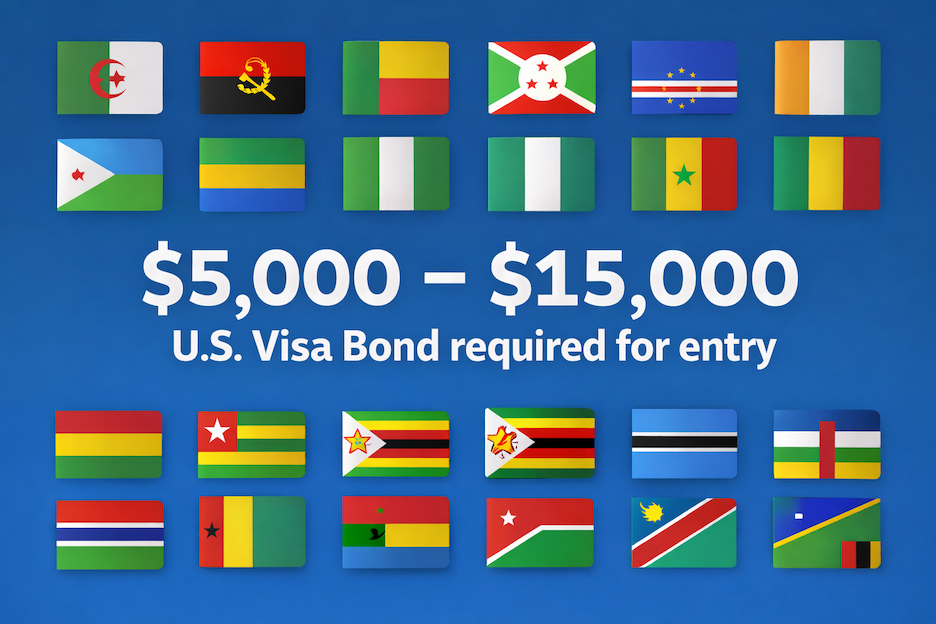
Under a visa bond program that has been broadened in recent months, citizens from these African countries including Algeria, Angola, Benin, Burundi, Cape Verde, Côte d’Ivoire, Djibouti, Gabon, Nigeria, Senegal, Togo, Uganda, and Zimbabwe must now post refundable bonds of up to $5,000–$15,000 when applying for U.S. B-1/B-2 visas, effective January 21.
This follows earlier designations of African nations such as Botswana, Central African Republic, Gambia, Guinea, Guinea-Bissau, Malawi, Mauritania, Namibia, Tanzania, São Tomé and Príncipe and Zambia that already went into effect earlier this month and last year.
The policy, which takes full effect as the list of affected jurisdictions has tripled since last year, extends a broader tightening of U.S. entry requirements—including mandatory in-person interviews and deeper vetting of social media and travel histories. The Administration’s stated objective is to curb visa overstays and strengthen U.S. immigration compliance, but business and government stakeholders across the U.S. and Africa are already wrestling with the broader strategic and economic fallout.
The expansion of the U.S. visa bond program—set against broader entry rule tightening—extends beyond immigration control into the realm of economic diplomacy. It stands to reshape how Africa and the United States interact commercially and culturally, with the potential to influence investment flows, diaspora engagement, and regional trade integration. For African governments and private sector leaders, navigating these new conditions will require coordinated diplomatic and business strategies that protect mobility, preserve market access, and sustain momentum in one of the world’s most dynamic economic regions.
This latest U.S. immigration move—which includes countries from South Asia, the Caribbean, and Latin America —also adds a new layer of friction to doing business with the U.S.—a long-time top export market and investment destination for African firms. By expanding the visa bond policy, Washington is effectively turning mobility into a balance-sheet issue, imposing upfront costs on executives, consultants, entrepreneurs, and dealmakers who once traveled on short-term visas with minimal bureaucracy. The result is likely to be slower deal-making, fewer in-person negotiations, and delayed project execution at a moment when African economies are actively courting U.S. capital and partnerships.
The impact will cut both ways. American companies with operations or partners across Africa depend on easy movement of personnel for market development, negotiations, and oversight. Higher entry barriers risk cooling U.S. corporate appetite just as both sides are seeking to deepen trade ties—and as Africa accelerates integration under the African Continental Free Trade Area. Supply chains, commercial relationships, and investment timelines are all vulnerable to disruption.
More broadly, the policy reflects a security-first U.S. posture that could reshape how Africa is priced in global capital allocation decisions. Although the bonds are refundable and do not guarantee visa issuance, the added cost and uncertainty act as a deterrent to mobile talent and senior leadership travel—key enablers of foreign direct investment.
AFFILIATE PARTNER BRAND
Visa policy, once a technical matter, has become a strategic economic lever, influencing competitiveness, partnership formation, and negotiating power.
African governments are unlikely to remain passive. Policy dialogues, diplomatic engagement, and even reciprocal measures are expected as countries seek to protect trade and mobility interests. The timing is delicate: as AfCFTA aims to lower internal barriers and position Africa as a unified market, external restrictions risk introducing new frictions between African businesses and global partners. That matters in a competitive landscape where the EU, China, India and Russia are actively courting African markets with fewer mobility constraints.
The softer dimensions of diplomacy are also exposed. Student exchanges, research collaboration, creative industries, and diaspora-driven entrepreneurship all rely on accessible travel. A bond that can reach $15,000 may discourage precisely the young professionals and cultural connectors who underpin long-term U.S.–Africa relations.
In tightening its borders, Washington may be reshaping not just who enters the country—but how it is perceived as a partner.