
Kemi Osukoya | December 16, 2025
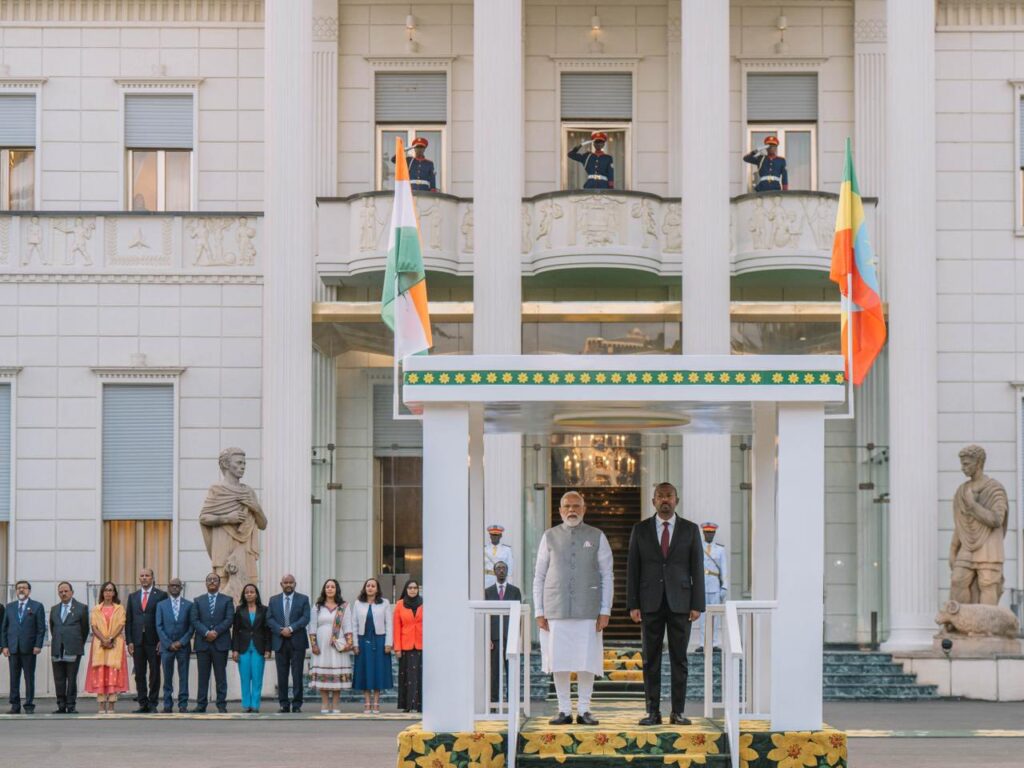
Ethiopia and India took a decisive step toward a deeper strategic and commercial partnership this week as Indian Prime Minister Narendra Modi arrived in Addis Ababa on Tuesday for a two-day landmark official visit, welcomed personally at the airport by Ethiopian Prime Minister Abiy Ahmed Ali.
The visit blended symbolism with substance. The two leaders began with Ethiopia’s iconic traditional coffee ceremony—an expression of hospitality, community, and heritage—before a ceremonial royal procession escorted Prime Minister Modi to the National Palace. There, high-level bilateral talks unfolded with senior ministers and officials from both governments, setting the tone for what both sides described as a modern, forward-looking partnership.
The warm and symbolically rich welcome from Prime Minister Abiy signals a decisive new chapter in India-Ethiopia relations—one firmly rooted in trade, technology, and South-South cooperation.
Abiy framed the visit as a milestone in Ethiopia’s global economic engagement.
“It is my great pleasure to receive Prime Minister Modi of India for his official visit. His presence underscores the growing ties between our two countries, and I look forward to meaningful engagements that will further deepen our cooperation across shared priorities,” he said.
Modi in turn hailed Ethiopia as a nation of “great history and vibrant culture, noting the two countries share deep civilizational links stretching back centuries.
“India and Ethiopia share deep civilizational ties. Ethiopia is the heart of African diplomacy, hosting the African Union headquarters. I look forward to engaging with Ethiopian leadership to further strengthen our partnership in diverse areas,” he noted.
From Friendship to Strategic Partnership
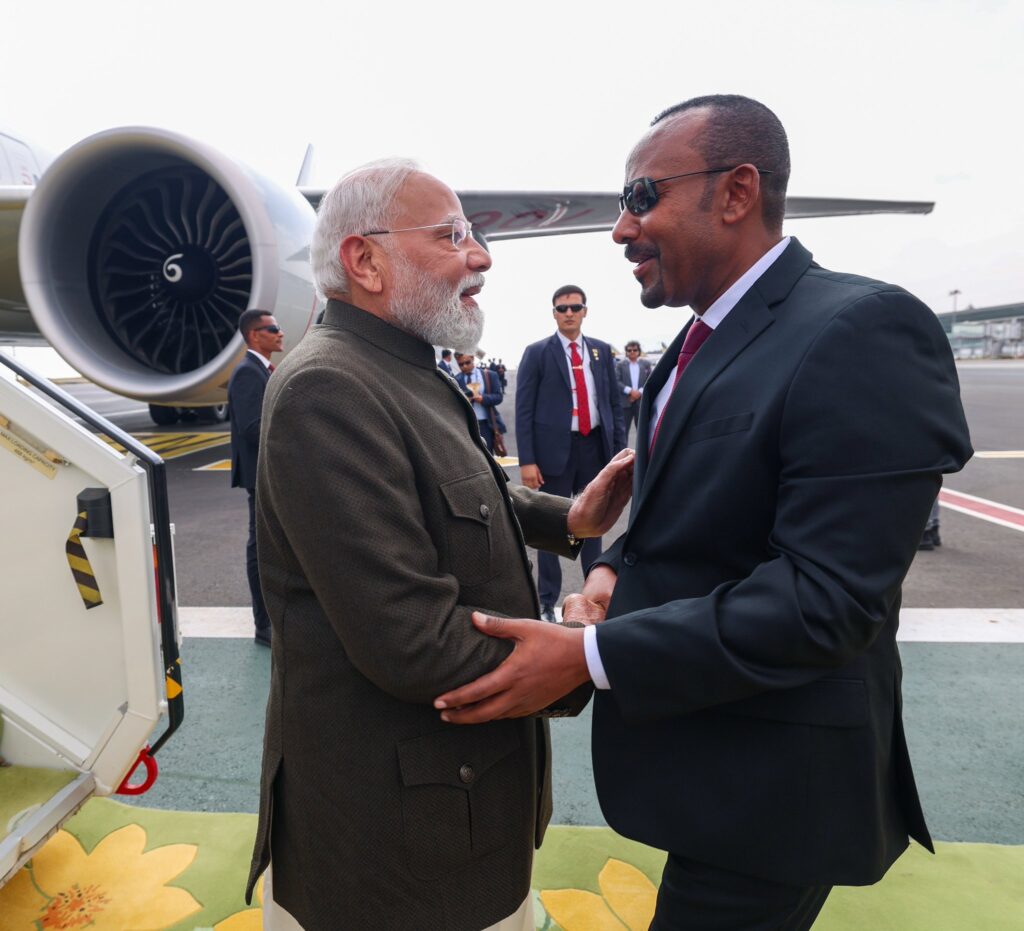
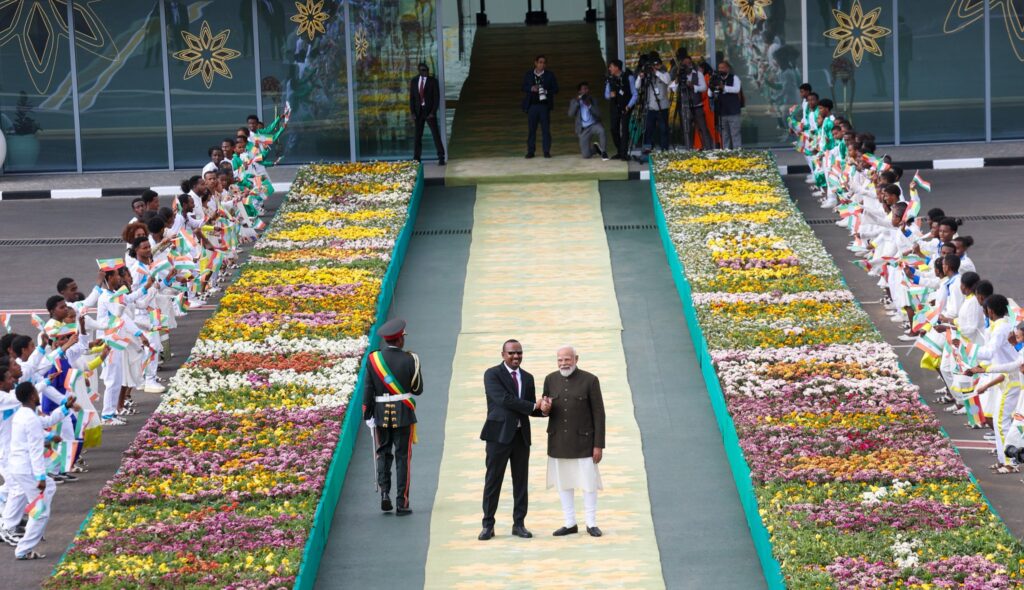
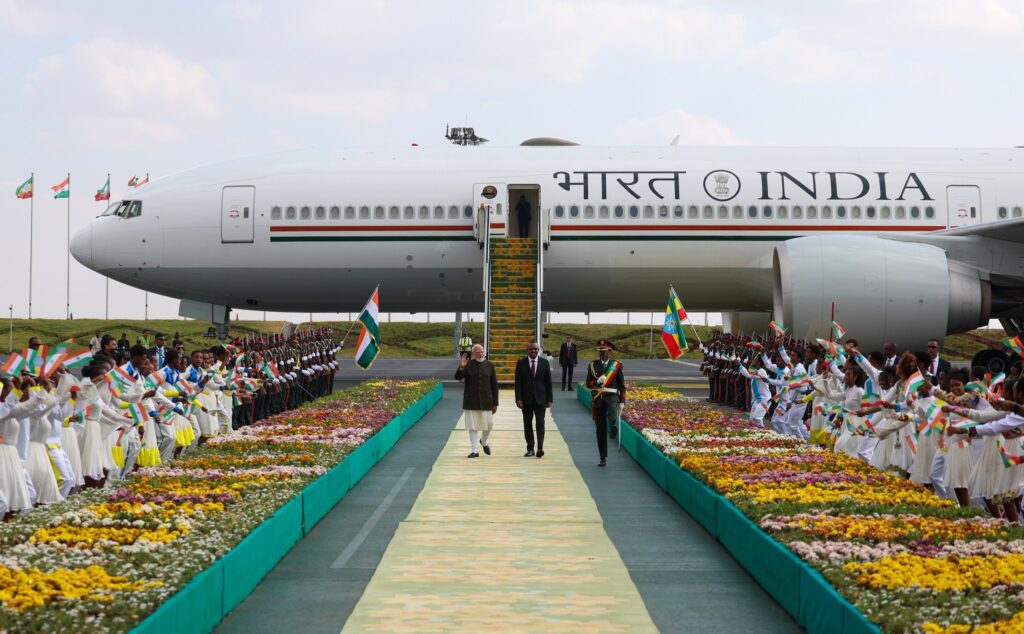
The visit marked a formal elevation of India-Ethiopia relations to a strategic partnership, reflecting expanding cooperation across education, trade, technology, digital infrastructure, healthcare, peacekeeping and economic reform.
Prime Minister Abiy described India as “a trusted friend,” emphasizing a shared vision rooted in sovereignty, self-reliance and practical cooperation. “We meet with a clear focus—to shape a modern partnership grounded in mutual respect and development,” he said.
Among the headline announcements, Prime Minister Modi revealed that India will double scholarships for Ethiopian students, significantly expanding access to higher education and professional training. New specialized short-term courses in artificial intelligence will also be introduced under India’s ITEC program, strengthening Ethiopia’s human capital in future-facing sectors
“This is about youth-to-youth engagement,” Modi noted. “Capacity building is the backbone of sustainable development.”
Deals Signed, Capacity Unlocked
The visit delivered tangible business-ready outcomes, anchored by the signing of multiple agreements and memorandum of understanding, including: enhanced cooperation on customs administration and trade facilitation, the establishment of a Data Center for Ethiopia’s Ministry of Foreign Affairs, a formal implementation for joint framework for UN Peacekeeping Operations training, a debt-restructuring MoU for Ethiopia under the G20 Common Framework, expansion of Indian Council for Cultural Relations (ICCR) scholarships and Artificial Intelligence-focused professional and technical training. In healthcare, India plans to support the upgrade of the Mahatma Gandhi Hospital in Ethiopia’s capital, particularly in maternal and neonatal healthcare
Priority Growth Sectors
Beyond the signed agreements, the two governments also advanced discussions on scaling collaboration in pharmaceuticals, digital health, and medical tourism, while also identifying energy and critical minerals as strategic, high-growth sectors for future trade, investment and technology transfer.
A Historic Honor
In a moment of historic significance, Prime Minister Modi was conferred Ethiopia’s highest national honor—the Great Honor Nishan of Ethiopia, which recognizes outstanding contributions in diplomacy, economic development and social advancement. He becomes the first foreign head of state to receive this distinction; philanthropist Bill Gates was the inaugural recipient earlier in June 2025.
“To be honored by one of the world’s most ancient and prosperous civilizations is a matter of great pride for me. On behalf of all Indians, I humbly accept this award. It belongs to countless Indians who have shared our partnership with Ethiopia,” Modi said in accepting the award.
Praising Abiy’s leadership, Modi added that Ethiopia’s development path under his vision stands as “a shining example for the world.”
Beyond ceremony and symbolism, the Indian Prime Minister’s visit signals a pragmatic recalibration of India’s engagements with Africa with positions Ethiopia as a strategic trade corridor anchor. For global investors and businesses, it signals market access, policy alignment and long-term opportunities. With Ethiopia emerging as a hub for African diplomacy and India positioning itself as a leading partner of the Global South, the strategic partnership opens new pathways for investment, innovation and shared growth.
For Africa, this visit underscores a clear message: India-Africa relations are no longer a sidebar, they are strategic, scalable and ready for business and Africa is emerging as a powerful engine for growth across the Global South.
The Prime Minister is expected to address a Joint Parliament on Wednesday before his departure for Oman, the final leg of his three-nation tour of Middle East and Africa.