
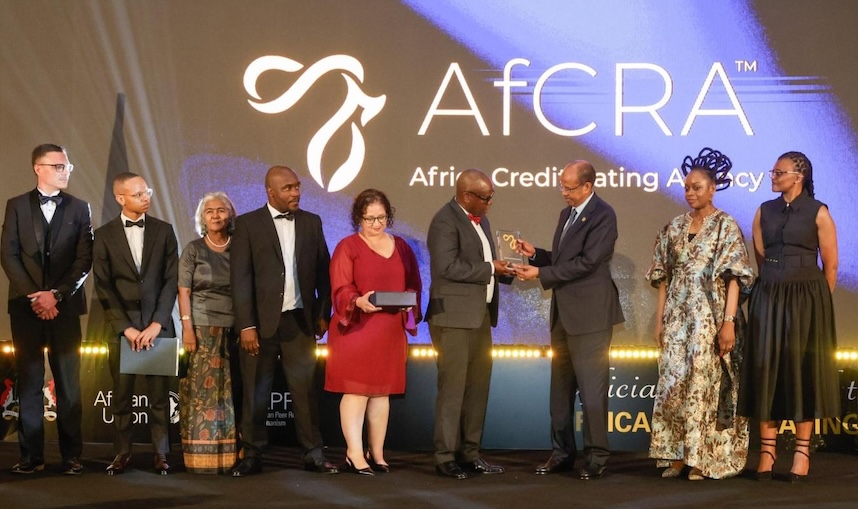
AfCRA builds on years of African efforts to challenge risk perceptions, expand access to debt and investment capital.
INSIDE AFRICA | FINANCE
Africa has launched a continental credit rating agency aimed at changing how the world assesses the risk of investing and lending across the continent, adding an African institution to a market dominated by the world’s largest rating companies and opening a new front in Africa’s effort to lower borrowing costs and strengthen its financial architecture.
The Africa Credit Rating Agency, or AfCRA, which was officially launched in Mauritius on Oct. 7, following years of work by the AU and the African Peer Review Mechanism, brought together African Union officials, finance ministers from across the continent, development financial institutions the United Nations, private-sector representatives and diplomats to address an important issue that many of them have raised concerns about: the cost of borrowing.
The agency’s launch comes at a pivotal moment for the continent as debate over Africa’s financing needs moves beyond how much money the continent requires to how that money is priced.
Sovereign ratings are used by investors to assess credit risk and can influence the interest rates governments pay when they issue bonds or seek loans.
The new agency is expected to provide independent and alternative assessments of African sovereigns as well as other credit risks, in complement rather than replacing international rating agencies such as Moody’s, S&P Global, and Fitch.
Speaking at the event, AU Commission Chairperson Mahmoud Ali Youssouf noted that credit ratings directly affect the cost and availability of capital, adding that African economies need to be assessed with greater access to African data, expertise, and economic conditions.
Youssouf said AfCRA was not being established to guarantee higher ratings or protect African borrowers from scrutiny. Instead, he said, it would provide an additional independent assessment of African credit risk.
African governments have for years argued that international ratings do not always capture the economic conditions and investment opportunities on the continent, a concern that has become increasingly important as countries confront high debt-service costs while trying to finance infrastructure, energy, healthcare and industrial development.
Former African Development Bank President Akinwumi Adesina was among the continent’s most prominent advocates for changing the way African risk is assessed.
During his decade leading the development bank, Adesina repeatedly challenged what he described as an excessive Africa risk premium, arguing that the cost of borrowing was being driven in part by perceptions that did not adequately reflect the continent’s economic realities and fundamentals.
Adesina estimated that more accurate assessments of African risk could save the continent about $75 billion a year in debt-service costs and lost lending capacity.
His argument was also reflected in the way the AfDB used its own balance sheet.
The AfDB maintained its AAA rating from the major international agencies throughout Adesina’s tenure, allowing it to raise funds in international markets and lend to African countries at rates below what many individual sovereigns could obtain on their own.
The bank also expanded the use of risk guarantees to attract private capital. Since 2019, the AfDB has approved more than $100 billion in partial credit and partial risk guarantees that mobilized about triple of that amount, according to Adesina.
For example, the Bank financed a $390 million loan for Benin supported by an AfDB guarantee and Egypt’s $500 million Panda bond, the first of such issuance by an African sovereign in the Chinese market.
Both transactions demonstrated why creditworthiness has become a central issue in Africa’s financing debate. Institutions with stronger ratings can generally access international capital at lower costs, while guarantees from highly rated development banks can help improve the terms available to borrowers.
AfCRA’s entry into that rating market will provide another assessment of the risks investors use when deciding how much to charge African borrowers.
From the AfDB to the G20
The push for changes in how African risk is assessed was put on the G20 agenda in 2025 during South Africa’s G20 presidency, as part of the group’s cost of capital and debt sustainability agenda.
South Africa called for greater scrutiny of sovereign credit-rating methodologies and identified the proposed African Credit Rating Agency as one possible response to concerns about how developing economies are assessed.
The issue was also raised in an Africa Bazaar interview last year with Eswatini Finance Minister Neal Rijkenberg, the designated representative of the AU at the G20 Finance Ministers and Central Bank Governors Meetings during South Africa’s presidency.
Rijkenberg discussed the importance of improving Africa’s credit ratings and ensuring that investors had a more accurate understanding of the continent’s economic conditions.
His comments came as African governments were pressing the G20 to address the high cost of financing faced by developing economies. The argument was not limited to whether African countries deserved higher ratings. It also focused on whether the methodologies used to determine those ratings adequately accounted for African economic data and conditions.
That discussions continue on debt sustainability and the cost of capital, including calls for greater transparency in sovereign credit assessments and reforms to the international financial system under the current U.S. G20 presidency .
AfCRA’s launch now gives that discussion a permanent institutional platform.
A new player in Africa’s debt market
The agency’s significance will ultimately be measured in financial markets.
When governments issue bonds, investors price those securities according to their assessment of the probability that the borrower will repay. A lower credit assessment can translate into higher yields, increasing the government’s interest bill over the life of the debt.
For countries already allocating a large share of government revenue to debt service, even small changes in borrowing costs can have significant fiscal consequences.
This is one reason African officials have linked credit ratings to development financing.
Youssouf said at the launch that inaccurate or incomplete assessments of African economies can increase borrowing costs and constrain financing for infrastructure, health, education, energy and industrialization.
AfCRA will give investors another source of analysis when evaluating those risks.
The agency could also expand coverage of African companies and financial institutions that receive little attention from the major international rating agencies. More extensive coverage could provide institutional investors, banks and other lenders with additional information when considering African assets.
That could become particularly relevant as African countries seek to develop domestic and regional capital markets and rely less heavily on foreign-currency borrowing.
But AfCRA will not, by itself, change the underlying creditworthiness of African borrowers.
African governments will still need to manage public finances, maintain sustainable debt levels and provide investors with reliable economic and fiscal information. The agency will also have to demonstrate that its ratings are independent of governments and other interests.
Those requirements were repeatedly emphasized at the launch.
Marie-Antoinette Rose Quatre, chief executive of the African Peer Review Mechanism, said AfCRA’s credibility would depend on ratings that are evidence-based, transparent and technically rigorous. The APRM has been involved in developing the agency’s institutional and technical framework since the African Union endorsed its creation in 2017.
African governments will also be expected to provide accurate and timely data.
That creates a two-sided responsibility for the continent’s financial system: AfCRA will be expected to improve the quality and context of its analysis, while governments will have to provide the information needed to make that analysis credible.
Building the financial infrastructure
Mauritius was selected to host AfCRA due to its established financial sector, regulatory framework and links to African and international markets.
Mauritius Finance Minister Jyoti Jeetun said the agency could help deepen African capital markets and connect international investors with opportunities in infrastructure, renewable energy, telecommunications, healthcare and agribusiness.
The agency is also being established alongside other efforts to strengthen African financial institutions, including AfDB and Afreximbank—which has expanded trade and investment financing, while the AU continue to push for greater African participation in global financial institutions and decision-making.
AfCRA adds a ratings institution to that financial infrastructure.
As the continent policymakers celebrate the launch, the immediate question is whether investors will accept AfCRA assessments and incorporate them into investment and lending decisions.
AfCRA’s first ratings will provide an early indication of how that approach translates into practice.