
CULTURE
If Afrobeats pioneer Fela Anikulapo-Kuti and Miriam Makeba—”Mama Africa” herself—could look down from heaven today on Hollywood Boulevard, one can only imagine their pride.
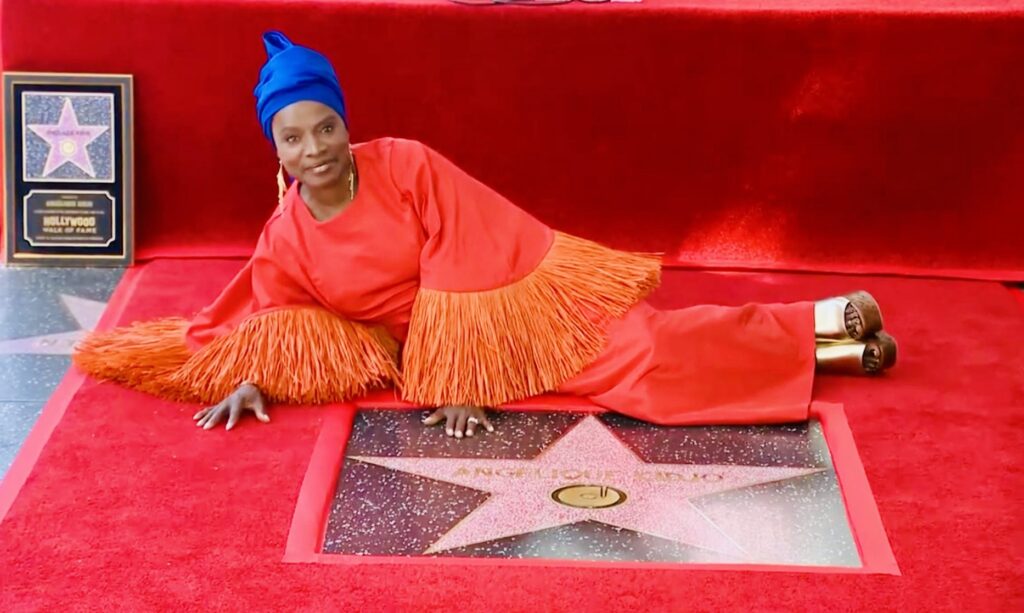
On a sunlit mid-August morning on Hollywood Boulevard, Angélique Kidjo joined a small fraternity of music icons and Hollywood legends whose names are etched in one of the world entertainment industry’s most famous landmarks as her name took its place on the Hollywood Walk of Fame. The five-time GRAMMY winner became the first Black African artist to receive the honor, with her star placed across from the Roosevelt Hotel.
It was more than a Hollywood moment. It was a moment for Africa.
The stars have finally aligned for African music.
For 65-year-old Kidjo, the occasion was both a personal achievement and a broader statement about the place of African music in the global canon.
“We Africans don’t know what we have given to the world, that we continue giving to the world for the music to exist,” Kidjo told a gathering of family, friends, artists, musicians and industry executives in attendance at the Walk of Fame ceremony. “Without us, there’s no music possible on this planet.”
It was a powerful declaration—and a true one that captured the historic ceremony. From the African percussion of Congo drums and Shakere, melodies have emerged, sounds that have traveled, transformed, and returned in countless forms as jazz, blues, soul, funk, hip-hop, reggae, Afrobeat, and beyond.
To listen to Kidjo is to hear Africa in motion. Her music—a catalog reflecting the rhythms of Africa that move effortlessly between music genres from Afrobeats, American R&B, funk, jazz, gospel, Latin music to classical repertoire, Irish rock, pop, and the rich tradition of the African diaspora—is a passport stamped with joy, resistance, memory and an unwavering belief in human connection that has made Kidjo an influential cultural bridge at a time when African artists are increasingly visible in mainstream global markets.
Her musical collaborations—including Yo Yo Ma and Bono have paired African languages and rhythms with songs and traditions from elsewhere, including interpretations of Talking Heads and the Cuban singer Celia Cruz.
Actor Willem Dafoe, who has watched Kidjo command stages around the world, called her “the hardest-working woman in show business.” Speaking at the ceremony on Tuesday, he described the transformation that occurs at Kidjo’s concerts: audiences arrive expecting to listen, only to find themselves on their feet, dancing in celebration.
“She has an ability to bring people together,” Dafoe said. “She brings joy and connection.” He then added a title that felt both fitting and inevitable: “She is truly a queen of African pop.”
And she is. But Kidjo is not a ceremonial queen seated on a throne. She is a working artist, activist, cultural ambassador and fierce advocate for girls and young women. Through her Batonga Foundation in Benin and Senegal, she has helped create opportunities for girls and young women to learn, lead and dream beyond the limits placed before them.
Harvey Mason Jr., chief executive of the Recording Academy and MusiCares, described Kidjo as one of those rare artists whose impact reaches far beyond awards, streaming numbers and chart positions. Recalling her recent performance before global leaders in Abu Dhabi, he remembered a room changed by her presence.
“A room full of individuals from every corner of the world became a community connected by one person,” Mason said. “That’s the power of Angélique.”
For Kidjo, music has never been simply a career. It has always been a calling—personal, political and spiritual. Like Fela, who used Afrobeat as a weapon against injustice, and Makeba, whose voice carried Africa’s pain, beauty and dignity across the world, Kidjo has spent more than four decades ensuring Africa is not merely heard, but deeply felt.
It is felt in the young girl who sees a woman from Benin standing unapologetically on the world stage; in the musician who understands that their own voice, language, and story belong in the global conversation and in the person who hears a familiar African rhythm in a faraway city.
Now, with the 2,854th star on the Walk of Fame, bestowed on her by the Hollywood Chamber of Commerce, Kidjo’s star shines not only for one artist. It reflects a continent whose music has long been part of the world’s heartbeat.
Her honor also arrives amid heightened global interest in African music and musicians, particularly Afrobeats, which has become a mainstay on international streaming charts, at concerts, and in nightlife scenes.
At the 68th Annual Grammy Awards ceremony earlier this year, the late legendary Nigerian musician and Afrobeat pioneer Fela was posthumously awarded a Lifetime Grammy Achievement Award—the first African artist to receive such an award from the Academy. The Award followed a prior 2025 induction of his 1976 album Zombie into the Grammy Hall of Fame.
Even in a moment of celebration, Kidjo was looking ahead—toward building stronger economies for Africa’s youth, creating pathways for emerging African artists and preparing the next generation to thrive.
That may be the true meaning of her star.
From the six-year-old girl who started singing in her hometown of Quidah, in Benin to the woman who now commands concert stages, Kidjo’s journey to Hollywood is not only a testament to a woman from Benin who conquered the world with her voice. It is a beacon for every young African singer, dancer, dreamer, and creator who sees her and knows that their story belongs on the world stage too.
As Beninese President Romuald Wadagni said in a tribute statement to her, “It is with immense pride that I salute the awarding of a star on the prestigious Hollywood Walk of Fame to our compatriot. By becoming the first African artist to receive this global consecration, the Beninese icon etches her name in history and elevates to the summit the rhythms, creativity, and dignity of our entire Nation. Beyond her four decades of success and musical genius, her unwavering commitment to the education of young girls commands admiration. On behalf of the Beninese people, I extend to her my warmest congratulations.”